In Forex trading, speed and stability define success. Even a few milliseconds can decide whether a trade closes in profit or loss. Slippage, connection drops, or power failures can all disrupt execution at the worst possible moment. A virtual server keeps your platform running day and night, ensuring your strategy never stops. A Virtual Private Server (VPS) is an independent virtual machine located in a professional data centre. It operates continuously, unaffected by home-computer issues, unstable Wi-Fi, or power outages. Modern trading platforms can access more than 12,000 symbols, from Forex pairs to commodities and indices.
Scalping strategies depend on speed. When trades last only seconds, the difference between a fast and a slow connection can erase profits. Because order processing time is measured in milliseconds, placing your VPS for scalping near major financial servers - for example, in London or New York - is critical. Algorithmic systems, or Expert Advisors (EAs), must operate continuously to monitor signals and open trades automatically. Even a short connection drop can cause a missed entry or an unclosed order. Using MetaTrader 4 VPS or MetaTrader 5 VPS ensures full compatibility and fast order routing.
Core concepts: latency, proximity, and reliability
Automated trading depends on precision and consistency. High-impact economic news often causes rapid price movement. Traders trying to capture these spikes must rely on instant execution and absolute stability. A VPS for news trading gives you a direct, stable link to your broker during volatile sessions. Using a VPS also isolates your setup from local internet congestion that often occurs when news breaks. Select a data-centre location close to your broker. Allocate enough resources. Monitor latency and uptime. Enable platform auto-start. Choose a trusted provider. Every trading strategy, whether manual or algorithmic, depends on order-execution speed. With an automated trading setup, your platform must process real-time data and react instantly to price changes. Using the best VPS for forex trading ensures your orders are sent to the market without delay.
One of the biggest advantages of professional forex VPS hosting is its flexibility. You can run different trading methods - scalping robots, swing EAs, and news-based scripts - on the same server. Whether your focus is short-term execution or long-term position management, a VPS allows you to diversify strategies safely. Professional data centres include advanced firewalls, DDoS protection, and daily backups. When trading manually, a home PC can crash, disconnect, or overheat. But with a 24/7 trading server, your platform continues operating normally even if your local internet goes down. Moreover, most VPS providers offer system monitoring and instant reboot features.
Latency, proximity, and the key locations
Latency is the time it takes for your order to travel from your trading platform to the broker’s server. For scalpers and EA users, latency below 10 milliseconds can make a visible difference in trade results. Every millisecond saved increases the accuracy of your entries and exits. Latency is the round-trip time (RTT) between your server and your broker’s matching engine, measured in milliseconds. Under 10ms is the target for most algorithmic strategies. Latency and proximity determine execution quality more than raw hardware specs in many cases.
Locations commonly cited as optimal for forex scalping include:
- Equinix NY4, New York: The primary US hub for retail and institutional forex brokers. A VPS co-located in NY4 typically achieves 0.3ms-3ms to a broker in the same building.
- Equinix LD4, London: London processes roughly 38% of global FX transactions. LD4 co-location delivers 1-5ms to brokers in the same facility.
- Equinix FR2, Frankfurt: The main hub for EU-regulated brokers operating under BaFin or CySEC frameworks.
- Equinix TY3/TY8, Tokyo: Primary hub for JPY pairs.
- CME Aurora, Chicago: Critical for futures traders.
Two things to keep in mind: location is the first variable to optimize, and hardware comes after location. A VPS physically co-located in the same facility as your broker’s matching engine can drastically reduce latency, sometimes to sub-millisecond levels. If you trade across multiple markets, you may need more than one VPS in different locations to minimize latency to each market.
Co-location vs regional proximity
Co-location means hosting your VPS in the same physical data center facility as your broker’s matching engine. Co-locating reduces latency to under 1 millisecond in some cases. Regional proximity places your server near the broker’s data center but not in the exact facility. This can still yield sub-5ms to brokers in many scenarios and often comes at a lower cost. For many retail traders, regional VPSs cover the majority of brokers adequately, while true co-location is reserved for high-frequency or very high-volume strategies.
Major providers offer diverse proximity options. Some examples include:
- Beeks Financial Cloud: LD4 and NY4 co-located nodes, with direct broker connections in New York, London, and Tokyo.
- TradingFXVPS: locations designed for proximity to Equinix LD4/NY4 hubs with sub-millisecond capabilities in some plans.
- ForexVPS.net: 22 server locations with latency typically 1-5ms co-located or near-co-located.
In practice, latency benchmarks are best-case figures published by providers. It is essential to run your own trials, use pings during active sessions, and verify fill quality in trade logs to confirm execution reliability under real-market conditions.
Hardware and performance: what matters for scalping
MetaTrader 4 and MetaTrader 5-and most Expert Advisors-often run single-threaded. More cores do not necessarily help if clock speed is low. Look for 4.0GHz+ clock speeds and high single-thread PassMark scores. NVMe storage is significantly faster than traditional SSDs or HDDs and can dramatically improve tick-data logging and EA responsiveness. Some providers advertise NVMe storage and dedicated CPU cores to minimize jitter and ensure consistent performance during volatile periods.
There are two broad VPS categories:
- Dedicated CPU core VPS: Isolates CPU cycles to your instance, ensuring consistent tick processing speed during high volatility periods. This is often crucial for scalping EAs that are single-threaded or lightly multi-threaded.
- Shared CPU VPS: More affordable but introduces resource contention. The risk of CPU scheduler delays increases during peak market hours, potentially widening spreads and worsening fills.
RAM matters because chart data, indicators, and order-book information reside in memory. A minimum of 4 GB is recommended for a single-platform scalping setup; 8 GB or more is advisable for multi-EA configurations. NVMe storage is a standard for serious scalping setups in 2026. Likewise, maintaining a clean Windows installation and disabling unnecessary services helps reduce latency jitter.
Platform compatibility and setup considerations
Windows Server VPS is typically the easiest path for MT4/MT5, as well as cTrader and other Windows-based platforms. Many providers offer pre-installed trading software with one-click deployment and optimized settings. Linux VPS can be cheaper and might be suitable for some algorithmic setups, but MT4/MT5 do not run natively on Linux, which can introduce latency and stability concerns if you rely on Wine or virtualization layers.
For scalping:
- Prefer Windows VPS with native MT4/MT5 support and Windows licensing included in the plan.
- Prefer dedicated CPU cores over burstable or shared resources to avoid unpredictable latency.
- Ensure NVMe storage for fast tick data logging and low IOPS latency.
- Configure a clean OS with minimal background services to reduce jitter.
Cost analysis and value proposition
VPS pricing typically falls into three bands:
- Budget VPS ($10-30/month): Shared CPU, lower clock speeds, 2-4 GB RAM, standard SSD. Useful for testing but may not sustain tight-spread scalping reliably during high volatility.
- Professional VPS ($30-80/month): Dedicated CPU cores, 4-8 GB RAM, NVMe storage, multiple data-center options, and 24/7 monitoring. Suitable for most retail scalpers running multiple EAs with tight latency requirements.
- Enterprise VPS ($80+/month): Co-located infrastructure, white-glove support, and highly customizable networking for very high-volume or near-0ms latency needs. Typically reserved for institutional-scale operations.
Choosing the right VPS requires weighing proximity to the broker’s data center, network quality, data-center reliability, and regulatory environment. For many traders, a properly located dedicated-core VPS in the $20-35/month range provides the best balance of performance and cost. In some cases, a single London or New York VPS suffices to cover multiple brokers hosted in LD4/NY4, while multi-market traders may need separate locations for dominant venues.
Best practices for selecting and testing
- Locate near your broker’s data center and verify the exact data center (for example, LD4, NY4, LD5, NY5, etc.).
- Run latency tests and pings during active sessions; compare demo results to your local machine.
- Test fill quality by analyzing trade logs and MT4/MT5 journals during news events and volatile sessions.
- Take advantage of trial periods to compare latency, uptime, and performance under real market conditions.
- Validate uptime guarantees (SLA) and ensure automatic failover capabilities if you rely on automated strategies.
For scalpers, the primary takeaway is that location matters most. A near-co-located VPS in the broker’s matching engine facility minimizes RTT and reduces slippage, while robust hardware and reliable uptime keep your trading system operating through volatility. Sub-5ms latency is often achievable in top hubs, and sub-1ms is the benchmark for institutional-grade setups. However, for most retail scalpers, sub-2ms to sub-5ms with consistent reliability delivers the practical edge needed to stay profitable.
When you’re unsure across several brokers, London is a common default, as many brokers cluster their engines in LD4. Always confirm with your broker which data center hosts their trading servers, or ping their gateway from a trial VPS to determine proximity. If your broker serves multiple hubs, consider running more than one VPS to optimize latency to each market. In practice, proximity to the trading engines is the single most important factor for scalping success.
Illustrative summaries and practical notes
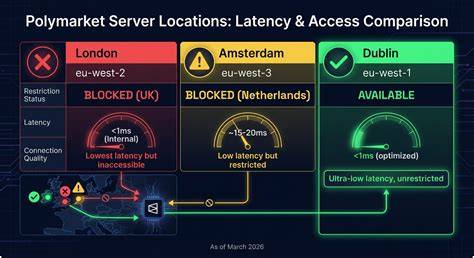
Latency goals: under 10 ms for most algorithmic scalping; sub-1 ms for high-frequency setups. Proximity-first, hardware second. Co-location offers the fastest round-trips, but regional proximity often suffices for many scalpers at a lower cost. For futures trading, Chicago (CME Aurora) is central; for FX, London (LD4) or New York (NY4/NY5) are typical defaults. Always test with your broker’s data center and use trials to confirm real-world performance during volatility.
Finally, remember that VPS choice is an infrastructure decision with rapid financial implications. A well-located, dedicated-core VPS with NVMe storage, under consistent load, and reliable uptime can convert a profitable strategy into a consistently profitable one, while a slower or unstable setup can erase edge quickly in a fast-moving market.