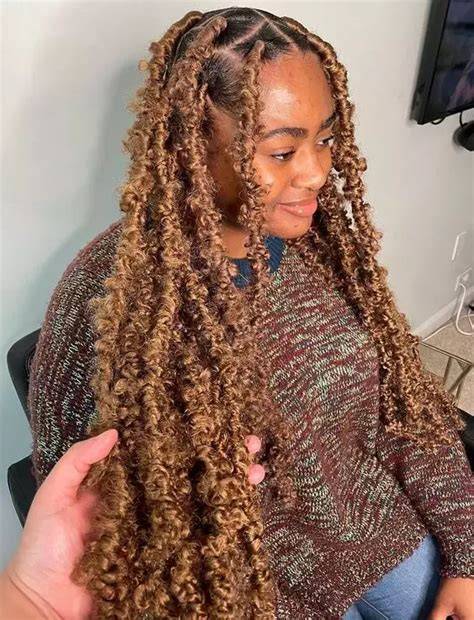
Butterfly Locs are the hot new style in these streets. I’ve literally been seeing them everywhere! They’re the love child of Goddess Locs and Passion Twists. It’s funny, the little mistake (a little loop of hair sticking out the braid) that I’d make when braiding is the signature characteristic of this style. Here’s EVERYTHING you need to know about Butterfly Locs-from install to maintenance to takedown.
What are Butterfly Locs? Butterfly locs are a faux loc hairstyle that is also a protective style that has an ‘undone’ look to them. While regular locs are typically straight and smooth, butterfly locs have ‘wave’ to them, and are characterized by looking more distressed and lived-in than traditional locs, giving them a signature boho vibe. Butterfly locs are like the perfect mix of goddess locs and passion twists. The messy, bohemian style is ethereal, low maintenance, and very natural looking.
What Type of Hair to Use and How Much
Depending on how long your natural hair is and how long you want your locs to be, you may need two types of hair. If you want locs that aren’t longer than your own hair, you’ll need roughly 6-8 packs of some type of water wave hair in 22-28 inches. If you decide to go with locs that are longer than your own hair, you’ll need filler hair. Technically, you can use the wavy hair to fill the locs too and can buy more of it for that purpose. But many tutorials use Marley hair to create an individual braid that you’ll then wrap with the wavy hair. Simply braid the Marley hair into your hair to the desired length.
Recommended Hair: 22″ FreeTress Water Wave; 18″ Sensationnel Lulutress Synthetic Crochet Braid; Niseyo Butterfly Locs Pre-Looped Crochet Hair 12″ (Crochet method only); AMELI 6 Packs Marley Braiding Hair (Optional, 1-2 packs).
How to Do Butterfly Locs
There are a couple different methods for installing Butterfly Locs, but regardless of the method you use, you may want to start by first soaking the hair you’ve purchased (if it’s synthetic) in an Apple Cider Vinegar rinse. Usually one part vinegar, two parts water suffices. Soak the hair for a couple of hours and rinse thoroughly. This helps avoid itching if you have a sensitive scalp.
Braid and Wrap Method
Step 1: Braid or twist your hair. Choose a parting pattern and braid or twist your hair. Use Shine and Jam or any edge control to keep the parts neat. Step 2: Prep your Water Wave hair. This step can be done as you go or you can do it all in the beginning. Simply take two pieces of the water wave hair and separate them. You want the result to be fluffy but still relatively together. Step 3: Crochet the Water Wave hair into the base of your braid. Take the crochet needle and place it through the base of your braid, by your scalp. Put the separated water wave hair in the needle’s hook, close it and pull it through less than halfway. You’ll want about ¾ of the water wave hair on one side to start wrapping. Step 4: Begin to wrap. Now grab the shorter piece of the water wave hair and hold it with your braid. Then begin wrapping the braid, and the shorter piece against it, with the longer piece of water wave hair. You’ll want to wrap the root 5-6 times to make sure it is secure against the scalp. The thumb technique helps create the loops. Step 5: Seal the Ends. When you reach your desired length, close off the loc and seal the ends by creating a small loop with your finger and wrapping the remaining hair back up the braid. Do NOT burn the ends.
Step 6: Finishing touches. The loops and the slightly messy wrap create the signature butterfly look. You can adjust tension to avoid hair damage and ensure comfort. The crochet method is a popular time saver; a professional install is recommended for best results.
Crochet Method
If you’re more comfortable with the crochet method-which takes less time-you can cornrow down your hair, but leave the front and back out for individual braids/twists so your style has versatility. Mary K Bella demonstrates using the crochet method with hair that isn’t pre-Loc’d, which is helpful right now as there aren’t a TON of already loc’d Butterfly Locs hair. This method is noted as a time saver and effective for achieving the look without extensive braiding first.
Butterfly Locs on Longer Hair
If you have long hair but want to rock bob-length locs, it’s easier than you think-no haircut necessary. You can fold the braids before wrapping to achieve a bob-length butterfly loc look. Longer styles tend to have thinner locs to reduce weight and scalp tension.
Maintaining & Refreshing Butterfly Locs
Maintaining butterfly locs involves keeping your scalp clean, moisturized, and minimizing build-up. A clarifying shampoo once a week helps keep the locs looking their best. Wearing a bonnet to bed reduces friction and frizz. Avoid excessive edge control to keep build-up to a minimum. Massaging the scalp with oil two to three times a week promotes healthy hair growth and reduces itchiness. Use mousse on flyaways to keep a finished look and consider occasional retwisting or re-wrapping as needed.
Can you wash Butterfly Locs? Yes, but you won’t have full access to your own hair, especially with the braid-and-wrap method. With the crochet method you have slightly more access, but still not complete. To minimize risk, limit wear to about four weeks and thoroughly dry the locs after any wash. Use a cleansing spray or dry shampoo to maintain scalp health between washes.
Takedown
As a general rule, keep protective styles in for about four weeks, particularly if you’re not washing them regularly. To remove Butterfly Locs, snip the end of the loc, unravel the hair, and carefully unwind from the base of the braid. Have oil and a spray bottle ready to loosen any buildup, taking breaks if you feel fatigued. The no-fuss method by The Chic Natural and Adanna Madueke offer practical approaches for taking down without damaging natural hair.
Inspiration and Variations
Butterfly Locs come in a range of colors and lengths, from shoulder length to waist length, with ombré tones and two-tone effects adding depth. Celebrities like Zendaya, Teyana Taylor, and Ciara have showcased similar boho-inspired protective looks. The style is versatile: top buns, half-up half-down, side parts, and ombre variations all work well with the loops and lived-in texture.
- Top Buns
- Half Up Half Down
- Long and Loose
- Traditional Bob
- Platinum Blonde or Two-Tone Shades
Pre-loc’d Butterfly Loc Hair is becoming more available, with brands like Janet Collection, Toyotress, and Niseyo offering options. Crochet method remains a popular choice for saving time, especially for beginners. As the style grows, more brands and color options will appear on the market.
For learning, watching tutorials from experts like Sandi-Kaye Henry and Antoine McCants provides guidance on installation, care, and the boho look. The style remains protective, versatile, and expressive, offering a modern interpretation of traditional faux locs with a relaxed, carefree finish.