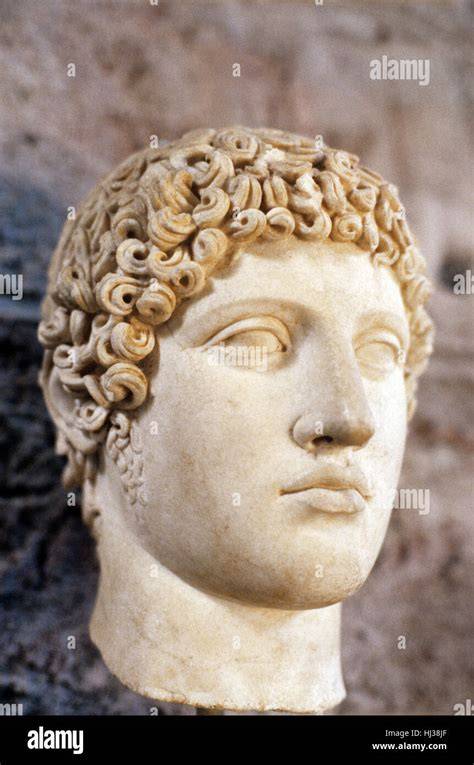
Statue and myth coexist in the visual culture of ancient Greece, where hair often functions as a seal of character and virtue. From the intense gaze of bronze charioteers to the serene marble faces of philosophers, most Ancient Greek statues feature elaborately curly hair. It might be tempting to dismiss this as a stylistic quirk of the era, but those heavy, coiled locks are anything but incidental. Parian and Pentelic marble were prized by sculptors in the Ancient Greek world for their radiant, almost luminous quality. Yet they came with a critical limitation. While marble can bear substantial compressive weight, it is far weaker under tension. Carving thin, unsupported elements made the material highly vulnerable to cracking. To address this, artists compacted the hair into tightly controlled forms. By shaping the locks into dense, interlocking curls, they kept the mass anchored close to the head and neck. With no fragile strands projecting outward, the sculpture avoided structurally vulnerable points.
The Artemision Bronze represents either Zeus, the ancient Greek king of the gods of Mount Olympus, or possibly Poseidon, the god of the Sea. Over time, artisans leaned into this reality. They began using drills to carve deep recesses within the curls, allowing light and shadow to do much of the work. Even so, practical concerns alone do not fully explain the phenomenon. The Ancient Greeks were guided by the principle of kalokagathia, an ideal that fused physical beauty with moral excellence. A full, animated head of curls signified a person’s thymos-their spirited energy, vitality, and heroic drive. In contrast, flat, thinning, or receding hair suggested the opposite, often serving as a visual cue for illness, lower social standing, or the diminishing strength of old age. Apollo, the god of light and artistic mastery, was traditionally depicted with abundant, flowing hair. Apollobrings peace and harmony and stops the war of the Lapiths with the centaurs.
Our modern perception of these masterpieces is somewhat misleading. Working with bronze involved the lost-wax casting technique in which artists first shaped their figures in soft, pliable beeswax. In this medium, pulling, twisting, and coiling hair into intricate ringlets was effortless, with no risk of breakage. Centuries later, when Roman artisans set out to reproduce these celebrated bronzes in marble, they preserved the hairstyles exactly as they were. For all the mathematical precision applied to these figures, classical sculpture never fully detached from the physical world. The people of Athens, Corinth, and Sparta naturally had textured, often wavy or curly hair-a trait that remains common across the Mediterranean.
To bridge to the modern experience of hair in Greece, consider how contemporary Athens embraces and treats curly hair. From stylists offering dry cuts tailored to curls to dedicated curl-care approaches, the city reflects a continuing appreciation for natural texture. Curly hair often requires specialized techniques, whether in sculpture or salon practice, to honor its pattern while ensuring durability and vitality. In ancient and modern contexts alike, curls signal energy, movement, and individual identity, linking marble and modern haircare in a shared Mediterranean narrative.
Connections Between Ancient Techniques and Modern Practices
The shift from wax to marble did not erase the aesthetic logic of curls; it translated the same visual grammar into a more durable medium. Drilled recesses within the curls create play between light and shadow, a principle still familiar to photographers, sculptors, and hairstylists. The idea that hair encodes character-thymos in antiquity and personal style today-provides a throughline from Praxiteles’ workshop to contemporary salons.
Key Themes Across Time
- Material and technique shape how curls are formed and read, from lost-wax bronze to marble carving.
- Hair functions as a visual cue for vitality, social status, and virtue within kalokagathia.
- Modern Greek curlicues in hair and in sculpture share a common Mediterranean texture and sensibility.
Choose from venues offering curly hair services and observe how modern stylists negotiate curl patterns, density, and movement, much as ancient sculptors negotiated mass and balance. In Athens, a landscape of salons and specialists demonstrates a contemporary commitment to curl care that echoes the ancient attention to form and function. Curly hair FAQs mirror the ancient concern with how hair communicates character, energy, and health, while also addressing practical questions about cutting techniques, product choices, and appointment booking. For those curious about both the art of sculpture and the science of hair, the continuity is striking: texture, shape, and expression remain central, whether chiseling a marble head or shaping a head of curls.