Across both Slavic and Finno-Ugric cultures, hair was generally a symbol of health, beauty, vitality, and spiritual strength, and how one’s hair was presented could tell a lot about a person, particularly a woman.
Young, unmarried women traditionally wore a single braid adorned with a ribbon. If the ribbon started at the top of the braid, it signified that the woman was actively seeking romantic pursuits. In contrast, several ribbons starting mid-braid indicated she was in a committed relationship and soon to be married. During the wedding ceremony, her single braid would be untied by her girlfriends amidst tears and songs lamenting her lost freedom, this ritual was called “rozpletiny”. Her hair was then brushed and tied into two braids, symbolizing her new status as a married woman. While covering the hair was not necessary prior to being married, after the completion of the marriage ceremonies, the hair would always be covered.
After giving birth and years into my marriage, I naturally gravitated toward wearing two braids-or my “crown,” as I like to call it. It wasn’t a deliberate decision to follow tradition but rather a personal preference. I find this style not only beautiful but also incredibly practical. Caring for a young child often made self-care an unattainable luxury, and this hairstyle has the added benefit of looking even better after a few days without washing your hair.
For me, the most intriguing aspect of hair magic begins with the untying of braids. “Unbound” hair was often essential for performing magical rituals and was frequently associated with demonic possession. A woman with her hair down was seen as extending an invitation-for intimacy, for magical forces to connect with her, and for dark spirits from other worlds to leave her messages. I have often wondered why that is?
In both Slavic (Russian) and Finno-Ugric (Erzya) folklore, most characters and spiritual entities are depicted with long, unbound hair. Two of the main Erzya goddesses, Vedyava (Goddess of water) and Viryava (Mistress of the Forest), are described as having long hair covering their bodies and faces. The Russian Rusalka is also known for her flowing hair, which she continuously brushes under the moonlight. Figures like Vodianoi, Domovoi, and Leshy are portrayed with long, often messy, unbound hair. Interestingly, even in Vasnetsov’s depiction of the half-woman, half-bird, Alkonost (the happy one with socially accepted behaviour) has her hair neatly tucked away from the viewer, while her troubled sister Sirin is shown with her hair loose, fraying in the wind.
If we are to consider my thoughts as having merit, my conclusion is this: With this understanding, everything else begins to fall into place. In burial rituals, where the plakalshitsa would “tear her hair out” in agony, she was ritualistically engaging in a socially unacceptable act-an unbound flow of grief and tears, roaring with the raw, untamed power of the wild bear. In birth rituals a mother would often wipe her newborn’s face with her hair as a symbolic move meant to protect the child from evil spirits. In abundance and prosperity rituals women would run around naked in the fields with the hair flowing in the wind all to make sure that the spirits would grant their communities a good harvest.
In my personal practice, while I don’t have an opportunity to run around naked in the fields of rye (regrettably), I always perform tarot readings and rituals with my hair freshly washed, unbound, and brushed. This is both a conscious nod to tradition and a personal preference, as I feel more open to receiving spiritual messages and ancestral wisdom when my hair is free and exposed to the elements. I ensure my hair is freshly washed to prevent the residue of daily worries from interfering with the process. The ritual act of brushing my hair helps me spiritually “arrange” my energy, clearing the path for messages to come through directly rather than “getting lost in the tangles.”
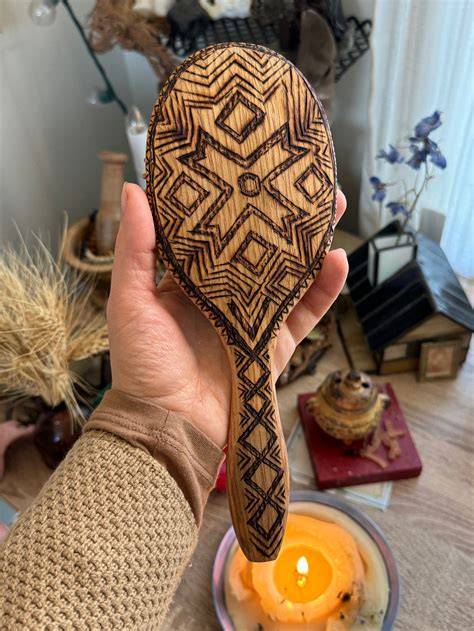
To make the act of brushing even more potent, I’ve wood-burned Erzya symbols and runes into my brush. This not only symbolizes my personal commitment to my Erzya heritage but also honors our traditional crafts, such as wood-burning, which are deeply rooted in our relationship with trees and the ethnic practices of Tree Worship.
One of the most famous divination rituals is where young unmarried women would brush their hair with “greben” (a crest), saying: “Суженый мой ряженый, явись ко мне наряженный, расчеши мне волосы” ("My betrothed, my adorned one, appear before me dressed up and comb my hair") and placing the crest under her pillow to see the face of her future betrothed in her dreams. In another popular ring pendulum divination performed during Svyatki, the hair of a happily married woman (or sometimes the hair of the person performing the ritual) was tied to a ring to create a pendulum.
Hair (and nail clippings) was often carefully guarded because it was believed not only to be a potential tool for curses but also an essential element in the afterlife. At the Last Judgment, one would have to account for every part of their body. This belief explains the dismay caused by Peter the Great's edict requiring Russian men to shave their beards. A fascinating account from Captain John Perry in 1716 tells of a carpenter who, while obeying the law and cutting off his beard, kept the hair hidden inside his shirt so that he could eventually be buried with it and present it to St. Nicholas on Judgment Day.
While I don’t collect every hair I’ve ever lost, I do believe my hair to be the conduit for energies. I rarely wear my hair down in social gatherings or even errands (unless seeing my very close group of friends that I trust) because I’ve found it makes me uncomfortable, emotionally frazzled and leaves me feeling vulnerable. I tend to have my hair in a bun, a braid or the two braid style tied around my head. On especially vulnerable days (first few days of follicular phase, waning moon, low health days) I veil either with scarfs, dad hats or nestle my head in a hoodie. To finalize the article I’ve put together a list of my beliefs and guidelines around hair, some are just personal and some are cultural:
I intuitively have mostly stopped getting haircuts since I became pregnant. My child is now almost 3 and I had only one haircut by a professional (just to cut off dead hair) and the rest I’ve been cutting myself, only tiny bits of the ends on the waning Moon to let go of the past cycle. I don’t know how to explain it without sounding crazy, but I feel like my spiritual stamina has multiplied because of that. I have never colored my hair. At first, my parents wouldn’t let me when I was young, but around 19-20 years old I remember taking a picture of myself in the field of wheat and I just loved how much my overall complexion matches the colors of the landscape and ever since I feel like the color of my hair carries a bit of my native land with me and I don’t want to let it go. Performing rituals and readings only with my hair down, freshly washed (but dry) and brushed.
Rarely wearing my hair down in social gatherings, but I will use any opportunity to brush my hair on a tree when I’m alone in nature: Doing nettle hair rinses (just water from steeped nettle leafs) as an added layer of spiritual protection; Brushing hair with a wooden brush with a tool that carries meaning and is personalized to me. Mine has wood-burnings of Erzya symbols, alternatively you can write your own symbols and sigils on it; Veiling with scarfs, hats, hoodies (you can additionally put a protective sigil on all of those too); My goal is to create more hair accessories that not only offer protection but also infuse my personal style and tradition into my look. Next on my list is a nakosnik or kosnik-a beautiful ornament worn at the end of a braid, traditionally made from birch bark and beads.
As has been described before on this blog, the Ancient Egyptians believed that hairloss was a sign of divine retribution. If you offended the gods, according to the people of Ancient Egypt, then they might cause your hair to fall out as a sign of their displeasure. That said, some of the Egyptian gods such as Ptah, the god of creation were themselves bald. Before the modern era, hair loss was, like many other symptoms, associated with maleficium or black magic. Both witches and fairies were believed to inflict hair loss on innocent people. This folkloric idea can be found in modern children’s literature. Eva Ibbotson, a renowned children’s author, wrote a wide variety of stories about all sorts of fantastic supernatural beings from ghosts to witches. Her novel The Secret of Platform 13 features a group of mysterious hags called The Old Ladies of Gloominess, who know all manner of spells for causing misfortune. Another example hails from Terry Pratchett’s Discworld novels.
There is no scientifically verified method for performing black magic with hair. The belief in black magic using hair exists in different folklore traditions. Some cultural and magical traditions believe that hair can be used symbolically in rituals because it is personally connected to its owner. There are historical folklore traditions describing hair-based rituals, but there is no scientifically verified method for performing black magic with hair. Hair fits this idea particularly well because it is physically connected to an individual. No ritual can scientifically guarantee another person’s love, loyalty, or feelings. Historically, some folk beliefs have claimed that another person could use a lock of hair as a symbolic link to its owner.
From a folklore perspective, beliefs and stories about using someone’s hair in magical practices do exist. Hoodoo is an African American folk-magic tradition with a complex history and should not simply be treated as another name for Voodoo. Voodoo/Vodou has specific religious and cultural traditions. Hair was particularly significant because it came directly from the person’s body. This concept appears in different forms across folklore and magical traditions. There are historical folklore traditions describing hair-based rituals, but there is no scientifically verified method for performing black magic with hair. The Belgravia Centre likewise notes that even in contemporary clinics, claims of hair loss caused by magic remain unverified by science.
In summary, hair has long functioned as a symbolic thread linking personal identity, ritual practice, and beliefs about the unseen. The idea behind hair and black magic is usually based on a simple concept: because hair once belonged to a particular person, some traditions believe it retains a symbolic connection with that individual. Historical collections show hair associated with protection, love, remembrance, and spiritual practices. The underlying belief is that the hair maintains a symbolic connection with the person it came from, even as scientific evidence remains absent.
Infographic suggestion: a timeline showing hair symbolism from birth to marriage to death across Slavic and Erzya traditions, highlighting unbound hair in rituals and protective practices.
Slavic Paganism - Hidden Power of Hair (short story adapted based on 1844 Slovak poem "Detvan)
Video suggestion: a concise explainer on how unbound hair is linked to spiritual access and boundary setting in Slavic and Finno-Ugric folklore.
| Topic | Key Points | Sources |
|---|---|---|
| Unbound hair | Associated with ritual power, intimacy, and demonic messages | Story excerpts from folklore and personal practice |
| Marriage ritual | Braid untied, then two braids; hair covered afterward | Rozpletiny description |
| Protection and harvest | Hair rituals tied to blessings, fields, and safety from evil | Birth and abundance rites |