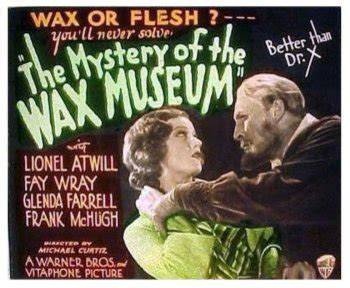
House of Wax is a 2005 slasher film directed by Jaume Collet-Serra in his feature directorial debut and featuring an ensemble cast consisting of Elisha Cuthbert, Chad Michael Murray, Brian Van Holt in a dual role, Paris Hilton, Jared Padalecki, Jon Abrahams and Robert Ri’chard. It is a remake of the 1953 film of the same name, itself a remake of the 1933 film Mystery of the Wax Museum, based on the story "The Wax Works" by Charles S. Belden.
House of Wax premiered at the Tribeca Film Festival on April 30, 2005, and was theatrically released in the United States on May 6 by Warner Bros. Pictures. It grossed $70.1 million worldwide and received generally negative reviews from critics, who criticized the film's lack of originality, screenplay and characters, but praised the performances and atmosphere.
En route to a football game, Carly Jones, her delinquent twin brother Nick, her boyfriend Wade Felton and their friends - Dalton Chapman, Paige Edwards and Blake Johnson - set up camp for the night in a wooded area. A stranger in a pickup truck arrives, then leaves after Nick damages one of the truck's headlights. In Ambrose, which is virtually a ghost town, mechanic Bo Sinclair offers to sell Carly and Wade a fan belt and drive them back to their car after he finishes attending a funeral. While waiting, they visit the central feature of the town - "Trudy's House of Wax", a wax museum-like tourist trap which is itself, like everything inside, made of wax. They follow Bo to his house to get the fan belt; Carly waits in his truck while Wade goes inside to use the bathroom. Wade is soon ambushed and abducted by Bo's twin brother Vincent, who wears a wax-made mask to cover his facial disfigurement from when they were once conjoined.
Realizing they will not arrive at the game in time, Paige and Blake return to the campsite while Nick and Dalton arrive in Ambrose to look for Carly and Wade. When Carly attempts to call for help, Bo cuts off the tip of her index finger. She eventually gets Nick's attention as he fends off Bo and rescues her, while Dalton finds Wade as part of the House of Wax, restrained in coated wax. Dalton tries to free him by peeling off the wax from his face, inadvertently removing his skin in the process.
While searching the town for help, the Joneses realize that the wax figures, both in the House of Wax and placed around Ambrose to make it appear populated, are actually the wax-coated corpses of its inhabitants and visitors lured there. Vincent had been attempting to continue the wax sculpting work of his mother and the House of Wax's creator, Trudy Sinclair, following her death, but Bo began manipulating him into making more realistic figures out of their victims. At the campsite, Vincent murders Blake and chases Paige into an abandoned sugar mill, where he does the same to her using a metal pipe. Vincent encounters the Joneses in the House of Wax's basement as Nick unintentionally incites a building-wide inferno. Upstairs, Nick battles Bo and is stabbed in the leg before Carly beats Bo to death with a baseball bat. A vengeful Vincent chases Carly to the top floor where she tries to reason with him but then fatally stabs him with Nick's help.
The next morning, local authorities, having seen the fire’s smoke, arrive and report about how Ambrose had been abandoned for the past decade ever since the local sugar mill went out of business. As the Joneses are driven away in an ambulance, one of the officials is told that the Sinclair family had a third son. Screenwriters Chad Hayes and Carey W. Hayes co-wrote the screenplay for House of Wax, adapting it from the 1953 film of the same name, itself a remake of the 1933 film Mystery of the Wax Museum, based on the story "The Wax Works" by Charles S. Belden.
Elisha Cuthbert was cast in the lead role of Carly. James Silver commented on her casting, highlighting her strength and range. Chad Michael Murray was cast in the role of Nick, Carly's delinquent twin brother, with producers noting a convincing brother-sister bond between Cuthbert and Murray. House of Wax was filmed at Warner Bros. Movie World on the Gold Coast in Queensland, Australia, with the town of Ambrose constructed nearby in Guanaba. The production design was led by Graham Walker, who had previously designed sets for Ghost Ship and Gothika.
On the technical side, the film’s 3D ambitions and wax-centric visuals were central to its reception. The film opened in 3,111 theaters and faced mixed critical responses to its use of 3D, with some praising the immersive atmosphere and others criticizing it as underutilized or gimmicky. Modern critics have been more positive about certain elements, noting the film revitalized Vincent Price’s presence in classic horror discussions and delivering a high level of genre entertainment despite its flaws.
Commercially, House of Wax performed respectably, grossing over $70 million worldwide. It opened to $12 million in its opening weekend and has since been released on various home media formats, including a Blu-ray collector’s edition in 2021. The film’s reception centered on debates about originality, character development, and the effectiveness of its gore and suspense, though performances by Cuthbert and Murray and the film’s unsettling atmosphere were consistently highlighted as strengths.
Additional context includes the film’s lineage as part of a lineage of wax museum-themed thrillers, tracing back to its 1953 predecessor and the 1933 Mystery of the Wax Museum. While critics have sometimes dismissed it as a rote rehash, others commend its efficiency as a horror experience and its mid-2000s gloss on classic genre tropes. The film’s finale, featuring a claustrophobic pursuit and explosive pyrotechnics, remains a focal point for discussions of its climactic execution and practical effects.
Why The My Bloody Valentine Remake Divided Horror Fans
In summary, House of Wax stands as a notable entry in early 2000s slasher cinema: a stylish remake that leans on atmosphere, practical effects, and a mixed cast to deliver a brisk, if imperfect, theatrical experience that continues to provoke conversation about how remakes honor or diverge from their progenitors.