There’s a persistent belief in hair care that you must trim your hair. Either you have to trim for growth or you have to trim to get rid of split ends or “dead” ends. But is it true? Do you need to trim your hair? What really happens if you don’t trim your split ends?
Not much. The belief is that split ends will continue to split all the way up the hair shaft and…I don’t know. Fall out? Make the hair weaker?
It’s been six years since I cut my hair. So my personal experience is this: I cut my hair from classic length to shoulder six years ago and I’m now at fingertip length. In those six years I did nothing for split ends until a couple months ago. (And I’ll explain more about what I’ve been doing in a moment). Not trimming had no effect on my ability to grow hair super long. My hair doesn’t look damaged. And I’m mystified by people who say you have to trim to grow.
The less you cut your hair the longer it will be. It is just basic common sense. There’s no specific point at which you say this hair is alive and this hair is dead. The ends can become crunchy and feel not as good. That is what people mean when they say dead ends. And there’s nothing wrong with trimming those if you want to. Your growth will be slower, though.
And before continually trimming those crunchy ends it’s better to take careful care of your ends. Use oils on them, tuck them in on hairstyles, wear a silk or satin sleep cap. Preserve them as best you can.
Trying to catch every split end. Trimming your hair regularly (what is regularly? Every six weeks? Twice a year?) can keep your hair looking thick and healthy. Without trims your hemline does usually develop taper that is called “fairy tale ends.” So if you like the look of a thick blunt hemline then trimming is for you.
But you should also be aware that splits don’t only happen at the ends. There can be damage from a brush or a ponytail holder, a hair that has broken off and then splits. Hairs in different parts of the growth cycle will be different lengths and any one of those could also get damaged and split.
You’re likely to drive yourself to distraction if you’re trying to keep your hair free of splits by trimming all your hair every time you see a split.
What should I do about split ends?
There is another way. Once a hair is split there is no way to stick it back together or fix it. Cutting it is the only solution. You can get some products that smooth your hair down and make it look unsplit but that is a very temporary fix. I’ve started doing what is known as SD or Search and Destroy on split ends. As I said, I’ve only been doing this for a few months and I’ve been able to grow my hair for years without doing anything about split ends. And in the cultures I mentioned there is no trimming of any kind, not even SD.
There are some nice benefits to SD. I have found it to be extremely relaxing and satisfying, a great method of self-care. It allows you to take care of splits without losing length. And for me it has made my hair feel smoother and softer, which I love.
You do is sit in a place with good light, put a towel or cloth with a contrasting color to your hair on your lap, get some very sharp scissors (hair cutting scissors preferable but whatever you use make sure they are only used for cutting hair). Blunt scissors will cause more splits. Then slowly go through your strands looking for splits. You can do that by twisting the length and looking at the hairs that pop out, or by taking sections and running them through your fingers.
When you see a split, isolate the hair and snip it just a little bit above the split. Since I had never done it before I had some strands with multiple splits on them! Your mileage may vary. For some people and some hair types split ends may impact them more than others. For those who have thin or light weight hair a few splits may be very visible and cause a look of frizz or damage. So take that into account for yourself. I just want to let you know that even hair advice that is taken as gospel everywhere you turn is not necessarily true.
UPDATE 2023: I haven’t done S&D in months but my hair has grown to knee length (50 inches on me). Never trimming has had the downside that my hair tends to be all different lengths so it can appear like it has more splits than it does. We get it. At times, your hair might not be feeling its best. Without its regular appointments to trim split ends, the ends feel dry and damaged and it’s not as easy to style. But equally, you’re not a trained hairdresser - one wrong move and you could be growing out your home haircut for years to come. So what’s the answer? Here’s our guide on how to trim your own split ends.
Dusting vs Trimming Split Ends. If you’re reluctant to lose any length, a new technique called ‘Dusting’ helps to rid your hair of split ends without losing any length. It’s a bit like de-fuzzing your clothes: all you trim are the flyaways that have split, leaving a sleeker, smoother look. On dry hair, comb hair through in small sections, then using shearing scissors (also called thinning scissors, they have fine ‘teeth’ along one of the blades), let the scissors catch the damaged hair. They can be razor-sharp, so handle with care.
When it comes to how to cut your own dead ends, trimming will always be the fail-safe approach. Removing whatever’s not healthy will ensure hair has a lovely thickness from root to tip, which will help improve things like shine and manageability, too. And here’s a little tip: when it comes to how to trim your own split ends at home, the best way is when hair is dry (wet hair is stretchier and more prone to damage). This is true for every hair type: straight, wavy, curly, coily. If you’re chopping off more than a few centimetres, you can comb through and make a horizontal cut first, but the most natural way is to hold a pair of hairdressing scissors pointing upwards and make vertical snips into the length. For women who only wear their hair curly, let your hair dry naturally before cutting. We’d recommend trimming each curl or coil individually, rather than sectioning the hair out and cutting across, to ensure a more even finish. And for women who love to change up their hair textures, a blowout before a trim works best.
Caring for Split Ends. The more hydrated your hair is, the more resilient against split ends it will be. Dove Nourishing Secrets Coconut Hydration Shampoo and Conditioner are specially formulated to nourish dry, brittle hair caused by weather conditions, hair styling techniques, harsh chemical treatments - or missing your regular styling appointments. And as well as rejuvenating dry hair, they help to keep hair healthy after it’s been cut, too: both products contain Nutritive Serum to lock in hair’s essential moisture in a lightweight formula that won’t weigh hair down - so you can use them every single day. In fact, the formulas are progressively nourishing - meaning your hair gets healthier looking after every wash. So now you won’t have to think twice about your split ends.
If you’re not heading to a salon, or even just need to space out your appointments - unleash your inner hair stylist - you won’t look back! Split ends leave your hair dry and damaged, so it’s important to remove them to promote healthy hair growth. Luckily, you don’t have to go to a hair salon just to trim your split ends-it’s easy to trim them yourself at home! In this article, we’ll teach you all the best ways to trim your own split ends.
Practical How-To: Step-by-Step at Home
Dry your hair and brush it out so that the split ends appear easily. It’s usually best to start on one side of your head so that you don’t get the sections of hair mixed up as you go along. Start at the top of the section of hair, twisting it as you go down. Continue twisting the strand until the entire section is twisted tightly. Examine the ends that are sticking out of the twist-most of them will likely be split ends. Use a pair of hair cutting shears to snip off about 0.2 inches (0.5 cm) of each split end. If you already have naturally straight hair, all you’ll need to do is brush through it thoroughly. If you have wavy or curly hair, it’s usually best to straighten it and brush it so that the split ends will pop up more easily. For the best results, use conditioner after every shampoo, massaging the conditioner onto the ends of your hair. A wide-tooth comb is less likely to damage your hair and it’s great for detangling. Trim your split ends to keep your hair healthy. Make sure your hair is damp-not soaking wet-and use a natural bristle brush or a metal comb to brush through it and remove any tangles. Then gather a 1 inch (2.5 cm) section of hair and trim ends perpendicular to the strand for a clean, even cut. If you have split ends that go far up the hair shaft, you may have to cut more than 0.8 inches (2.0 cm), but start with a small amount to be safe. Post-trim care matters: deep conditioning treatments help maintain moisture balance and reduce recurrence of split ends. Use heat protection if you style with hot tools and be mindful that tools can still take a toll on hair even after trimming.
Final note: Regular trimming every 6-8 weeks works well for many, especially with heat-styled or chemically treated hair which may need 4-6 week intervals. Curly hair tends to need trims more frequently due to higher risk of split ends and breakage. Listen to your hair: if you notice more splits or dryness, a trim can help, even if you’re aiming to grow longer.
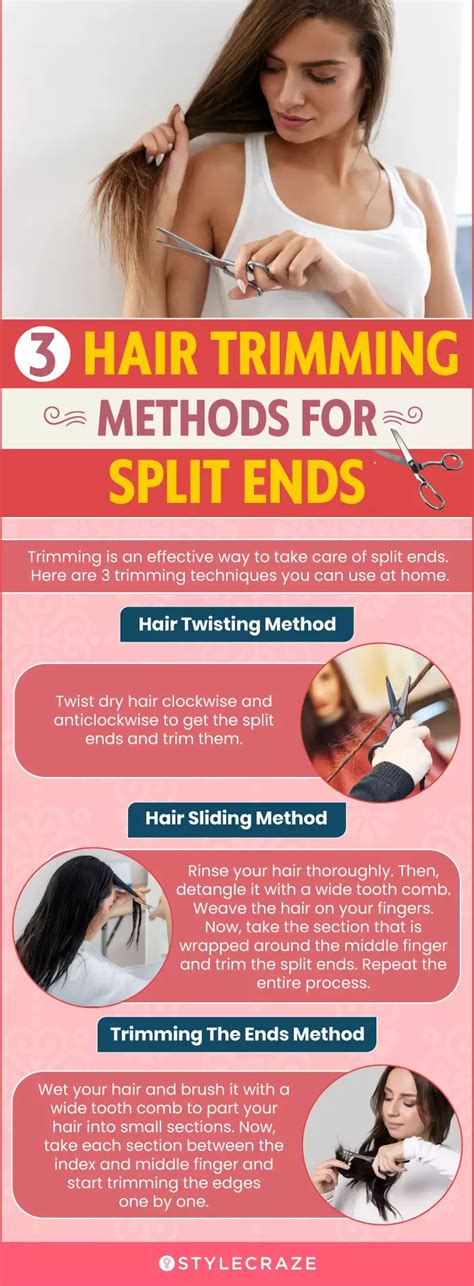
Key Takeaways
- Split ends cannot be repaired; trimming is the most reliable way to remove damaged portions.
- Regular trims help prevent splits from traveling up the hair shaft and support easier styling.
- Dusting is a gentler alternative to preserve length while removing flyaways.
- Hydration, proper brushing, and heat protection contribute to healthier ends between trims.