Unquestionably, modern car owners are exploring faster, safer ways to dry their vehicles after washing, with jet or air blower solutions emerging as a compelling alternative to traditional methods. Recent findings show that more than 70 percent of car owners still opt for automatic washes rather than DIY detailing, yet a dedicated subset of enthusiasts pursues optimized processes to the nth degree. Air blowers entered the chat as tools capable of drying vehicles with effectively zero risk of scratching the paint, offering a compact and mulitpurpose option beyond conventional leaf blowers.
In practice, air blowers are appealing because they’re considerably more compact than a traditional leaf blower, making storage and handling easier. However, the key question remains: can these smaller blowers rival the power and battery life of heftier cordless leaf blowers? This article synthesizes findings from hands-on testing and expert observations to determine which products are truly worth buying for car drying.
What to Look For in an Air Blower for Car Drying
- Performance: it should blast water away from the vehicle effectively without leaving streaks or spots.
- Battery life: long enough to dry an entire car or SUV in a single session.
- Comfort and ergonomics: the blower should be compact or light enough to maneuver without fatigue.
- Noise level: reasonable levels to protect hearing and maintain good relations with neighbors.
- Size and weight: the unit should be manageable and easy to transport.
The Control: Leaf Blower Benchmark
To provide a baseline, the test began with a conventional leaf blower, specifically Ryobi’s RY40LB01K, used as a control. This option demonstrates what a budget-friendly, all-purpose tool can offer in a drying scenario, including the pros of strong power and the cons of greater noise and bulk.
The model shown in the test was evaluated for time to dry, battery life, noise, and weight, with vital statistics recorded as follows: time to dry around 2 minutes 36 seconds, battery life about 15 minutes 48 seconds, noise at 73.4 dB, and weight at 8.45 lb. These metrics set a clear standard for comparing smaller air blowers against a familiar, larger leaf blower baseline.
Comparative Findings: Smaller Air Blowers vs. Leaf Blowers
Across multiple smaller air blowers, the central question was whether these compact devices could deliver comparable drying performance to a dedicated leaf blower while maintaining portability and reasonable sound levels. The core advantages of these air blowers include their reduced footprint and easy storage, which align with the needs of enthusiasts who value efficiency and organization in detailing workflows. Yet, power reserves and runtime remain critical factors that determine whether they can truly replace traditional drying methods in practice.
In our assessment, the air blowers showed promise in providing adequate airflow to remove surface water and minimize the risk of marring the paint. The compact form factor makes them attractive for detailing routines that require frequent tool changes and precise targeting of residual moisture in crevices and panels. Nevertheless, to match the performance of a robust cordless leaf blower, some models must balance weight, noise, and battery capacity to sustain a full-vehicle dry.
Practical Guidance: Choosing a Jet Blower Car Dryer
When evaluating options for your setup, consider prioritizing units with strong airflow, long-lasting battery life, and a comfortable grip that reduces hand fatigue during longer sessions. If your goal is to dry large vehicles efficiently, a high-capacity battery paired with a lighter, quieter design can yield the best overall experience. For smaller cars or tighter spaces, a compact air blower with precise nozzle control can deliver excellent results without sacrificing safety or speed.
It’s also worthwhile to test how a blower behaves with different nozzles and attachments, as these can influence both drying speed and the risk of unintended surface contact. A balance between power and control is essential to maximize drying efficiency while preserving finish integrity. Finally, consider the total cost of ownership, including battery packs and chargers, which may influence long-term value more than initial price alone.
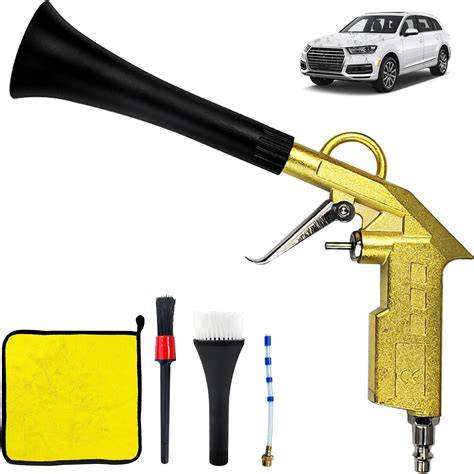
Practical Workflow Tips for Jet Blower Drying
- Begin with a thorough rinse to remove loose dirt, reducing the amount of water the blower must move.
- Use a broad, steady sweep to push water from panels toward lower areas and away from edges where water tends to pool.
- Target doors, mirrors, and crevices first, then move to larger surfaces to optimize time and energy use.
- Keep a consistent distance from the surface to avoid overly concentrated air that could push debris into gaps.
- Pair the blower with a microfiber drying towel for final touch-ups and to remove any remaining moisture quickly.
In practice, air blowers offer a compelling blend of portability and safety for detailing enthusiasts, especially when the goal is to minimize the risk of paint scratches while maintaining workflow efficiency. The choice between a small air blower and a larger cordless leaf blower ultimately depends on how much weight, noise, and battery life matter within your specific detailing routine.