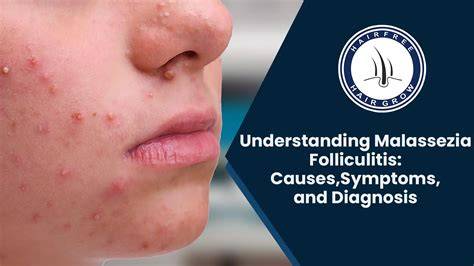
Malassezia folliculitis, also known as pityrosporum folliculitis, is an infection of the pilosebaceous unit caused by lipophilic Malassezia yeasts particularly M. globosa, M. sympodialis and M. restricta. Malassezia folliculitis presents as small, uniform, itchy papules and pustules particularly on the upper back and chest. Other sites involved can include the forehead/hair line, chin, neck, and extensor aspect of the upper limbs. Clinical examination raises the diagnosis. Potassium hydroxide preparation of skin scrapings may reveal budding yeasts.
Key Features and Diagnosis
The condition frequently mimics acne but lacks comedones and tends to present with uniform papules and pustules in follicular distributions. Dermoscopy can aid evaluation, and dermoscopic features may include follicular patches and perifollicular scaling. Confirmation can be supported by KOH microscopy showing budding yeasts, and culture or molecular methods may be used in uncertain cases.
Topical Treatments
Topical treatments such as selenium sulfide shampoo, econazole solution and topical ketoconazole are effective in the majority of cases but may require a longer course than systemic agents. Selenium sulfide has antifungal activity against Malassezia species and can be applied to affected areas as a shampoo or cream as directed. Antifungal azoles, like econazole and ketoconazole, can be used in topical formulations to reduce fungal load on the skin. Regular, consistent application over several weeks is often necessary to achieve clearance.
Oral Treatments
Oral treatment may be more effective than topical, although results of clinical trials have not consistently shown this. Systemic antifungals such as itraconazole or fluconazole are commonly prescribed for refractory cases or extensive involvement. Dosing regimens are typically tailored to severity and patient factors, and treatment duration is guided by clinical response. Monitor for potential side effects and drug interactions during systemic therapy.
Clinical Evidence and Considerations
Emerging literature supports both topical and systemic approaches, with some studies suggesting superior clearance with oral therapy in certain patient groups. However, evidence is not unequivocal and clinicians may choose therapy based on disease extent, patient tolerance, and response to initial treatment. Diagnostic stains, such as the May-Grünwald-Giemsa stain, and microbiological confirmation may support diagnosis and guide therapy choices. Research also encompasses epidemiological characteristics and the role of cutaneous resident Malassezia species as etiologic agents.
Important Points for Clinicians
- Consider Malassezia folliculitis in patients with pruritic, uniform follicular papules and pustules, especially on the trunk and upper limbs.
- Use potassium hydroxide preparation to identify budding yeasts on skin scrapings when feasible.
- Topical antifungals (ketoconazole, econazole) and selenium sulfide shampoos are first-line options for many patients.
- Reserve systemic antifungals for refractory or extensive disease, or when topical therapy fails to achieve clearance.
- Longer durations of topical therapy may be necessary compared with systemic therapy.
Diagnostics and Supporting Literature
Diagnostic and therapeutic strategies have been described in reviews and guidelines. For instance, epidemiological characteristics and diagnostic staining techniques have been explored in the context of Malassezia folliculitis. Evidence-based Danish guidelines discuss treatment considerations for Malassezia-related skin diseases. Additional studies examine dermoscopy and the role of diagnostic and treatment approaches in Malassezia-associated dermatoses.
Practical Treatment Pathways
- Initial assessment with clinical examination and KOH skin scrapings if available.
- Start topical therapy with selenium sulfide shampoo or azole antifungals (econazole or ketoconazole) as a first-line approach.
- Reassess after several weeks; if response is suboptimal, consider transitioning to or adding systemic antifungal therapy (e.g., itraconazole or fluconazole) depending on disease extent and patient factors.
- Continue therapy for an extended period as indicated by clinical response and tolerability; monitor for adverse effects during systemic treatment.
Emerging and Adjunctive Approaches
Photodynamic therapy has been explored as a new treatment for recalcitrant Malassezia folliculitis, with some reports describing favorable outcomes. Ongoing research into the microbiology and host factors continues to refine management strategies. Diagnostic approaches continue to evolve, including dermoscopy as an aid to clinical evaluation and differentiation from similar conditions.
Fungal acne (Malassezia folliculitis) versus Comedonal acne
Summary of Practical Advice
Effective management of Malassezia folliculitis centers on accurate diagnosis, appropriate use of topical antifungals and keratolytics, and consideration of systemic therapy for refractory cases. The choice between topical and oral therapy should be individualized based on spread, severity, and patient response, with longer courses often needed for topical regimens and careful monitoring during systemic therapy.
tags: #malassezia #folliculitis #face #treatment