Good old water, aka H2O. The most common skincare ingredient of all. One more thing: the water used in cosmetics is purified and deionized (it means that almost all of the mineral ions inside it is removed).
A handy multi-tasker, white to light yellowish oil-loving wax that works very well in oil-in-water emulsions. It makes your skin feel nice and smooth (emollient), stabilizes oil-water mixes and gives body to them. Oh, and one more thing: it's a so-called fatty alcohol - the good, emollient type of alcohol that is non-drying and non-irritating.
Probably the most common silicone of all. As for skincare, it makes the skin silky smooth, creates a subtle gloss and forms a protective barrier (aka occlusive). Also, works well to fill in fine lines and wrinkles and give skin a plump look (of course that is only temporary, but still, it's nice).
There are also scar treatment gels out there using dimethicone as their base ingredient. It helps to soften scars and increase their elasticity. As for hair care, it is a non-volatile silicone meaning that it stays on the hair rather than evaporates from it and smoothes the hair like no other thing.
A so-called fatty (the good, non-drying kind of) alcohol that does all kinds of things in a skincare product: it makes your skin feel smooth and nice (emollient), helps to thicken up products and also helps water and oil to blend (emulsifier).
Similar to other emollient plant oils, it's loaded with nourishing fatty acids: oleic is the main component (55-83%), and also contains linoleic (3.5-20%) and palmitic acids (7-20%). Castor oil is sourced from the castor bean plant native to tropical areas in Eastern Africa and the Mediterranean Basin. It is an age-old ingredient (it’s over 4,000 years old!) with many uses including as a shoe polish, food additive and motor lubricant.
So what is so special about it? The answer is its main fatty acid, called ricinoleic acid (85-95%). Unlike other fatty acids, ricinoleic acid has an extra water-loving part (aka -OH group) on its fatty chain that gives Castor Oil several unique properties. First, it is thicker than other oils, then its solubility is different (e.g. dissolves in alcohol but not in mineral oil), and it allows all kinds of chemical modifications other oils do not, hence the lots of Castor oil-derived ingredients. It is also more glossy than other oils, in fact, it creates the highest gloss of all natural oils when applied to the skin.
It’s the most commonly used version of pure vitamin E in cosmetics. The extract coming from the lovely herb, rosemary. It contains lots of chemicals, including flavonoids, phenolic acids, and diterpenes. Its main active is rosmarinic acid, a potent antioxidant, and anti-inflammatory.
Unless you live under a rock you must have heard about shea butter. But it's not only a simple emollient, it regenerates and soothes the skin, protects it from external factors (such as UV rays or wind) and is also rich in antioxidants (among others vitamin A, E, F, quercetin and epigallocatechin gallate).
It's an alternative, natural preservative that comes from radishes fermented with Leuconostoc kimchii, a lactic acid bacteria that has been used to make traditional Korean dish, kimchi. It’s pretty much the current IT-preservative. It’s safe and gentle, but even more importantly, it’s not a feared-by-everyone-mostly-without-scientific-reason paraben.
It’s not something new: it was introduced around 1950 and today it can be used up to 1% worldwide. It can be found in nature - in green tea - but the version used in cosmetics is synthetic. Other than having a good safety profile and being quite gentle to the skin it has some other advantages too.
An Ecocert-approved, natural preservative that counts as gentle and non-irritating to the skin. Usually, it comes to the formula as part of a preservative blend as it's not enough on its own.
Super common little helper ingredient that helps products to remain nice and stable for a longer time. It does so by neutralizing the metal ions in the formula (that usually get into there from water) that would otherwise cause some not so nice changes.
A mild, natural preservative that usually comes to the formula together with its other mild preservative friends, such as Benzoic Acid and/or Dehydroacetic Acid. A type of sugar that's part of a moisturizing trio called Aquaxyl. Exactly what it sounds: nice smelling stuff put into cosmetic products so that the end product also smells nice. If you are someone who likes to know what you put on your face then fragrance is not your best friend - there's no way to know what’s really in it. Also, if your skin is sensitive, fragrance is again not your best friend.
It’s the number one cause of contact allergy to cosmetics. Ci 19140 or Tartrazine is a super common colorant in skincare, makeup, medicine & food. FDA says it's possible, but rare, to have an allergic-type reaction to a color additive. CI 42090 or Blue 1 is a super common synthetic colorant in beauty & food. It’s a common fragrance ingredient that has a light floral smell. It’s one of the “EU 26 fragrances” that has to be labelled separately (and cannot be simply included in the term “fragrance/perfume” on the label) because of allergen potential. Best to avoid if your skin is sensitive.
Linalool is a super common fragrance ingredient. It’s kind of everywhere - both in plants and in cosmetic products. The problem with linalool is, that just like limonene it oxidises on air exposure and becomes allergenic. That’s why a product containing linalool that has been opened for several months is more likely to be allergenic than a fresh one. A study made in the UK with 483 people tested the allergic reaction to 3% oxidised linalool and 2.3% had positive test results. It's one of those things that help your cosmetics not to go wrong too soon, aka a preservative. No matter the origin, in small amounts (up to 1%) it’s a nice, gentle preservative. Has to be combined with some other nice preservatives, like potassium sorbate to be broad spectrum enough.
Normal (well kind of - it's purified and deionized) water. Usually the main solvent in cosmetic products. A very common silicone that gives both skin and hair a silky smooth feel. It also forms a protective barrier on the skin and fills in fine lines. A fatty (the good, non-drying kind of) alcohol that makes your skin feel smooth and nice (emollient), helps to thicken up products and also helps water and oil to blend (emulsifier).
Olive oil - an oleic acid-rich (55-83%) emollient plant oil that can moisturize dry skin. Also, it contains antioxidant polyphenols and vitamin E. Castor oil is sourced from the castor bean plant native to tropical areas in Eastern Africa and the Mediterranean Basin. A form of vitamin E that works as an antioxidant. Shea butter that's considered to be a magic moisturizer and emollient.
Pretty much the current IT-preservative. A common glycol that improves the freeze-thaw stability of products. An Ecocert-approved, natural preservative that counts as gentle and non-irritating to the skin. Super common little helper ingredient that helps products to remain nice and stable for a longer time. A type of sugar that's part of a moisturizing trio called Aquaxyl. The generic term for nice smelling stuff put into cosmetic products so that the end product also smells nice. It’s a common fragrance ingredient that has a light floral smell. A super common fragrance ingredient that can be found among others in lavender, ylang-ylang, bergamot or jasmine. The downside of it is that it oxidises on air exposure and might become allergenic. It's one of those things that help your cosmetics not to go wrong too soon, aka a preservative.
Discover the ultimate solution for dry, frizz-prone hair with Palmer's Olive Oil Deep Conditioning Pack. This intensive treatment is perfect for those seeking to rejuvenate and nourish their hair, leaving it strong, shiny, and manageable. Infused with Extra Virgin Olive Oil and a unique Botanical Scalp Complex, this conditioner soothes the scalp and smooths rough hair cuticles. Ideal for anyone looking to restore their hair's natural beauty, this deep conditioner is a must-have for your hair care routine.
Key Features
- Intensive Hydration: Deeply moisturises and nourishes dry, damaged hair.
- Extra Virgin Olive Oil: Cold-pressed from the Olea europaea tree fruit, providing rich moisture.
- Botanical Scalp Complex: Soothes and nourishes the scalp, reducing itchiness and dryness.
- Improves Manageability: Smoothes rough cuticles, making hair easier to style.
- Enhances Shine: Leaves hair looking glossy and healthy.
- Frizz Control: Tames frizz, making hair more manageable and sleek.
What are the benefits of using Palmer's Olive Oil Deep Conditioning Pack? Using this deep conditioner will result in stronger, shinier, and more manageable hair. It also helps to soothe and nourish the scalp, reducing dryness and itchiness.
How does Palmer's Olive Oil Deep Conditioning Pack work? The conditioner works by deeply penetrating the hair shaft with Extra Virgin Olive Oil and a Botanical Scalp Complex, providing intense hydration and nourishment to both the hair and scalp.
Are there any known side effects? There are no known side effects when used as directed.
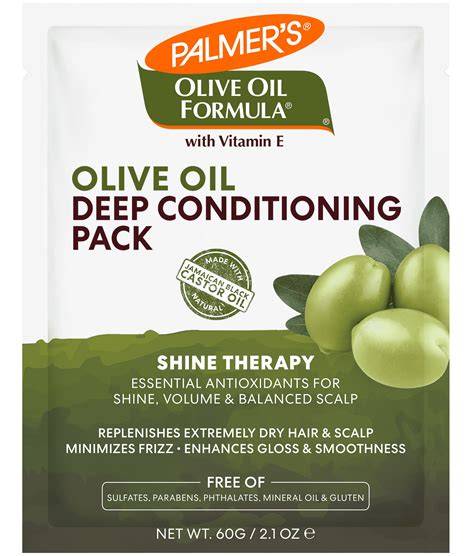
Palmers Olive Oil Leave-In Conditioner ~ Better than Kerastase?
For visual guidance, you may consider an infographic illustrating how extra virgin olive oil and botanical scalp complex hydrate and protect hair, along with a short video demonstrating the application steps for best results.
tags: #palmer #olive #oil #deep #conditioner