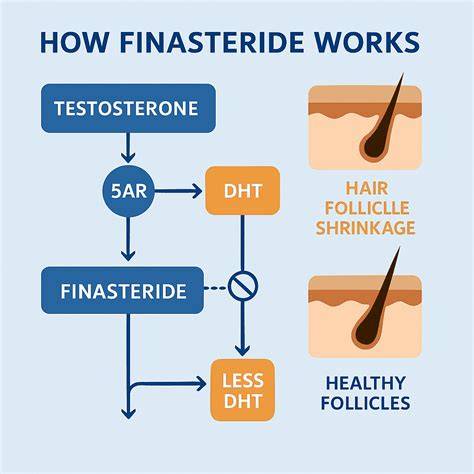
Androgenetic alopecia (AGA) is androgen-dependent and characterized by a hereditary inheritance pattern, beginning with the advent of puberty. In predisposed males and females, scalp hair progressively thins in a defined pattern, most often at the vertex, with non-scarring, progressive miniaturization of the hair follicle and shaft. In addition, transplants are associated with risks such as bleeding and infection. Systemic FNS, a 5-α-reductase inhibitor 4-aza-3-oxosteroid compound, has been extensively studied and is clinically used for the treatment of benign prostate hyperplasia (BPH) and AGA. FNS works by competitively inhibiting 5-α-reductase type 2, preventing the conversion of testosterone to DHT, markedly suppressing serum DHT levels. The mean terminal half-life of FNS is approximately five to six hours in men 18-60 years, and eight hours in men greater than 70 years of age. DHT levels return to normal within 14 days of treatment discontinuation. It is expected that after systemic FNS use for the treatment of AGA is stopped, reversal of hair regrowth occurs within 12 months.3 In its systemic form, various side effects such as gynecomastia, breast tenderness, malignant neoplasms of the male breast, decreased ejaculate volume, decrease in testicular size, testicular pain, reduction in penile curvature, reduction in penile size, sexual disorder, male infertility, high grade prostate cancer, and prostatitis have been reported.3 These side effects are often prohibitive as male patients are sensitive to sexual side effects. Oral finasteride has established itself as a highly effective treatment for androgenic alopecia (AGA) and is widely prescribed around the globe. However, despite its well-documented efficacy, oral finasteride has become equally notorious for its potentially systemic side effects. Some men experience adverse effects such as decreased libido, erectile dysfunction, mood changes, and even persistent symptoms after discontinuation, a phenomenon called post-finasteride syndrome.{{Diviccaro, S., Melcangi, R.C., Giatti, S. (2019). Post-finasteride syndrome: an emerging clinical problem. Neurobiology of Stress. 12. 100209.}} Recently, topical finasteride formulations have garnered attention as a promising alternative. By delivering the medication directly to the scalp, topical finasteride aims to minimize systemic absorption and thereby reduce the likelihood of side effects while still providing the benefits of DHT inhibition where it matters most. In this article, we will examine whether topical finasteride can serve as a viable alternative to its oral counterpart. Oral vs. Some research directly compares oral finasteride (1 mg daily) with various concentrations of topical finasteride, aiming to match hair regrowth efficacy while minimizing systemic side effects. {{Piraccini, B.M., Blume-Peytavi, U., Scarci, F., Jansat, J.M., Falques, M., Otero, R., Tamarit, M.L., Galvan, J., Tebbs, V., Massana, E., Topical Finasteride Study Group. Efficacy and safety of topical finasteride spray solution for male androgenetic alopecia: a phase III randomized, controlled clinical trial. JEADV. 36(2). 286-294.}} Systemic finasteride (oral) reduced mean serum DHT by 55.6%, whereas topical finasteride reduced it by 34.5%. Parallel-group comparison in male AGA, tracking hair density and systemic DHT.{{Bhura, M. (2013). Comparative Analysis of Topical and Oral Finasteride in Androgenetic Alopecia: Impact on Hair Growth, Systemic Absorption, and Adverse Effects. Indian Journal of Basic and Applied Medical Research. 3(1).}} Compared a 1% topical gel + placebo tablet with oral finasteride 1 mg/day + placebo gel.{{Hajheydari, Z., Akbari, J., Saeedi, M., Shokoohi, L. (2009). Comparing the therapeutic effects of finasteride gel and tablet in treatment of the androgenetic alopecia. Indian Journal of Dermatology, Venereology, and Leprology. 75(1). 47-51.}} Finasteride is a competitive inhibitor of 5α-reductase, primarily targeting the type II isoenzyme at therapeutic doses, which predominates in the hair follicles and prostate. At higher tissue concentrations, finasteride can also inhibit type I 5α-reductase, which is primarily found in the skin and sebaceous glands; however, its clinical significance for hair loss at standard doses is limited. By selectively inhibiting the type II enzyme, finasteride effectively lowers local and systemic DHT levels.{{Finn, D.A., Beadles-Bohling, A., Beckley, E.H., Ford, M.M., Gililland, K.R., Gorin-Meyer, R.E., Wiren, K.M. (2006). 12(1). 53-76. A New Look at the 5α-reductase Inhibitor Finasteride. CNS Drug Reviews. Finasteride’s effect on DHT suppression is characterized by a logarithmic dose-response curve, meaning that even very low systemic levels can produce a marked reduction in both serum and scalp DHT. Pharmacokinetic studies show that inhibition of type-II 5ɑ-reductase reaches saturation at typical clinical dosage, while type-1 enzyme inhibition requires much higher concentrations. This nonlinear pharmacodynamic profile explains both the strong efficacy and the wide safety margin of topical finasteride: a small amount achieves most of the desired effect, so careful formulation is crucial to maximize scalp delivery while minimizing unwanted systemic exposure.{{Suzuki, R., Satoh, H., Ohtani, H., Hori, S., Sawada, Y. (2010). Saturable Binding of Finasteride to Steroid 5ɑ-reductase as Determinant of Nonlinear Pharmacokinetics. Drug Metabolism and Pharmacokinetics. 25(2). 208-213.}} Topical finasteride has been studied across a 200-fold concentration range, from 0.005% solutions to 1% gels. Even a micro-dose of 0.005% twice daily (~0.1 mg/day) curbed shedding and improved density without measurable systemic suppression, making it an attractive option for highly risk-averse users.{{Mazzarella, F., Loconsole, F., Cammisa, A., Mastrolonardo, M., Vena, G.A. (1997). Topical finasteride in the treatment of androgenic alopecia. Preliminary evaluations after a 16-month therapy course. Journal of Dermatological Treatment. 8.}} Adding 0.1% finasteride to minoxidil amplifies regrowth compared to minoxidil alone, while standalone 0.25% sprays deliver oral-level scalp DHT blockade, maintaining serum exposure roughly one-tenth that of tablets. Dose and volume are critical.{{Caserini, M., Radicioni, M., Leuratti, C., Terragni, E., Iorizzo, M., Palmieri, R. (2016). Effects of a novel finasteride 0.25% topical solution on scalp and serum dihydrotestosterone in healthy men with androgenetic alopecia. International Journal of Clinical Pharmacology and Therapeutics. 54(1). 19-27.}} Topical finasteride options at 0.5% have been shown to extend benefits to female pattern hair loss with good tolerability.{{Rossi, A., Magri, F., D’Arino, A., Pigliacelli, F., Muscianese, M., Leoncini, P., Caro, G., Federico, A., Fortuna, M.C., Carlesimo, M. (2020). Efficacy of Topical Finasteride 0.5% vs 17ɑ-Estradiol 0.05% in the Treatment of Postmenopausal Female Pattern Hair Loss: A Retrospective, Single-Blind Study of 119 Patients. Dermatology Practical & Conceptual. 10(2). E2020039.}} Carrier Agent: The vehicle used to deliver finasteride dramatically alters absorption. Alcohol-based (ethosomal) carriers enhance drug penetration through the skin and into deeper layers like the dermis much more than conventional liposomes, which tend to remain more superficial. One study found that ethosomes resulted in approximately six times greater dermal accumulation than liposomes, highlighting the direct impact of carrier choice on systemic exposure.{{Rao, Y., Zheng, F., Zhang, X., Gao, J., Liang, W. (2008). In Vitro Percutaneous Permeation and Skin Accumulation of Finasteride Using Vesicular Ethosomal Carriers. AAPS PharmSciTech. 9(3). 860-865.}} Time on Scalp Before Washing: The longer finasteride remains on the scalp before washing, the greater the chance for absorption through the skin. Washing off too soon reduces drug uptake, but leaving it for extended periods increases both local efficacy and systemic exposure. Frequency of Use: If you can keep topical finasteride on your scalp for at least 10-12 hours, once-daily applications of low-dose topical finasteride might be beneficial. For those who can only tolerate finasteride for 4-6 hours, twice-daily applications may be better. Individual Skin Permeability: Personal factors, including skin thickness, barrier integrity, genetics, and even scalp conditions, can strongly influence how much finasteride penetrates the scalp. Individuals with more permeable skin may absorb a greater amount of the drug systemically, increasing the risk of side effects.{{Brito, S., Baek, M., Bin, B-H. (2024). Skin Structure, Physiology, and Pathology in Topical and Transdermal Drug Delivery. Pharmaceutics. 16(11). 1403.}} Before starting topical finasteride, get a baseline measurement of your serum DHT levels through a blood test. After one month of consistent topical use, repeat the serum DHT test under the same conditions (preferably in the morning, fasted, and at a similar time of day). This helps you gauge systemic absorption and adjust your regimen if your serum DHT levels drop excessively.{{van der Merwe, J., Brooke, N.E., Myburgh, K.H. (2009). Three weeks of creatine monohydrate supplementation affects dihydrotestosterone to testosterone ratio in college-aged rugby players. Clinical Journal of Sports Medicine. 19(5). 399-404.}} Visible improvements often require 12-24 months. Finasteride + Minoxidil: Studies show that pairing topical finasteride with 5% minoxidil yields superior hair density and patient satisfaction compared to either agent alone, particularly after 24 weeks of treatment.{{Apoorva, V.B., Vibhu, M., Singh, R.H., Smita, T. (2023). Comparative Efficacy of Topical Finasteride (0.25%) in Combination with Minoxidil (5%) Against 5% Minoxidil or 0.25% Finasteride Alone in Male Androgenetic Alopecia: A Pilot, Randomized, Open-Label Study. International Journal of Trichology. 15(2). 56-62.}} Efficacy of the association of topical minoxidil and topical finasteride compared to their use in monotherapy in men with androgenetic alopecia: A prospective, randomized, controlled, assessor-blinded, 3-arm, pilot trial. Journal of Cosmetic Dermatology. 23(2). 502-509.{{Rossi, A., Caro, G. (2023). Efficacy of the association of topical minoxidil and topical finasteride compared to their use in monotherapy in men with androgenetic alopecia: A prospective, randomized, controlled, assessor-blinded, 3-arm, pilot trial. Journal of Cosmetic Dermatology. 23(2). 502-509.}} Finasteride + Microneedling: Adding microneedling to topical therapy can significantly enhance outcomes. Clinical trials demonstrated that combining microneedling with minoxidil and/or finasteride increased hair density and shaft diameter more than minoxidil alone, with effects noticeable within just 12 weeks.{{Chang, Y., Zhang, W., Zhou, J., Lv, L., He, Q., Chen, Y., Wang, P., Zhai, Q. (2025). Clinical efficacy of microneedle combined with 5% Minoxidil solution and finasteride in the treatment of androgenetic alopecia in males. Archives of Dermatological Research. 317(428).}} Triple Topical Therapy: Preliminary studies on formulations that combine finasteride, dutasteride, and minoxidil show promising results, with visible regrowth as early as three months in some cases.{{Rafi, A.W., Katz, R.M. (2011). Pilot Study of 15 Patients Receiving a New Treatment Regimen for Androgenic Alopecia: The Effects of Atopy on AGA. ISRN Dermatology. 241953.}} So, combination therapy appears to be more effective than monotherapy. Topical finasteride is a legitimate option for hair regrowth. When formulated and used properly, it can rival oral finasteride’s effectiveness with a lower risk of systemic side effects. Success hinges on the right delivery method, correct dilution, and consistent application. For those hesitant about oral medication, topical finasteride offers a practical, lower-risk compromise, provided users carefully follow evidence-based protocols to optimize both safety and results. Dr. Sarah King is a researcher & writer who holds a BSc in Medical Biology, an MSc in Forensic Biology, and a Ph.D. in Molecular and Cellular Biology. While at university, Dr. King’s research focused on cellular aging and senescence through NAD-dependent signaling - along with research into prostaglandins and their role in hair loss. She is a co-author on several upcoming manuscripts with the Perfect Hair Health team.
Abstract
Currently, only topical minoxidil (MNX) and oral finasteride (FNS) are approved by the FDA and EMA for treating androgenetic alopecia. Although FNS is efficacious for hair regrowth, its systemic use is associated with side effects limiting long-term utilization. Exploring topical FNS as an alternative treatment regimen may prove promising. Seven articles were identified, including five RCTs and two prospective trials, with 256 subjects. Topical FNS consistently reduced scalp and plasma DHT, with no significant changes in serum testosterone. Preliminary results suggest safety and potential efficacy, though long-term data and optimal formulations require further study.
Introduction
Androgenetic alopecia (AGA) is a common chronic, cutaneous condition encountered by dermatologists globally. In predisposed individuals, DHT-driven follicular miniaturization underlies hair loss, with high scalp DHT and increased AR expression observed in affected areas. Systemic finasteride markedly suppresses serum DHT, but side effects limit its long-term use. Topical formulations aim to minimize systemic exposure while targeting scalp DHT to promote regrowth.
Methods
A search was conducted to identify studies regarding human in vivo topical FNS treatment efficacy including clinically relevant case reports, randomized controlled trials (RCTs), and prospective studies. Strict exclusion criteria were applied and they narrowed it down to seven articles: five RCTs and two prospective uncontrolled trials. A total of 256 (24 female, 232 male) human subjects were studied and results summarized.
Results
In all studies, there was significant decrease in the rate of hair loss, increase in total and terminal hair counts, and positive hair growth assessment with topical FNS. Both scalp and plasma DHT significantly decreased with application of topical FNS; no changes in serum testosterone were noted. Across studies, topical concentrations ranged from 0.005% to 0.25%, with once-daily dosing often providing favorable scalp DHT suppression and minimal systemic exposure. Some trials demonstrated that topical FNS could achieve reductions in scalp DHT comparable to oral FNS, while serum DHT reductions were consistently lower with topical formulations. Combination with minoxidil or microneedling appeared to enhance outcomes in several trials. Safety profiles were favorable, with few adverse events reported and no clinically significant events related to testosterone or sexual function in the topical groups.
- Mazarella 1997: topical finasteride 0.005% vs placebo for 16 months; moderate effectiveness in finasteride group.
- Hajheydari 2009: topical 1% gel vs oral finasteride 1 mg/day; both groups improved, oral group earlier.
- Rafi & Katz 2011: NuH Hair (topical dutasteride with minoxidil) showed significant growth.
- Tanglertsampan 2012: minoxidil alone vs minoxidil plus finasteride 0.1%; combined group improved more.
- Caserini 2014a: topical 0.25% vs oral 1 mg; DHT reductions 68-75% topical vs 62-72% oral; no testosterone changes.
- Caserini 2014b: part 1 compared once vs twice daily topical vs oral; serum DHT reductions varied with dose; scalp DHT reductions greater with topical.
- Chandrashekar 2017: retrospective topical 5% minoxidil with oral finasteride; switching to topical plus minoxidil maintained density in most patients.
Comment: These studies are helpful in determining the safety of topical finasteride for men who wish to avoid systemic side effects. The authors conclude that the most effective concentration and frequency at this time (suppressing scalp DHT with minimal serum DHT reduction) is achieved with doses of 100 µL (0.2275 mg) and 200 µL (0.455 mg) topical finasteride 0.25% solution applied once daily. However, additional questions remain about use in women, combination strategies, and vehicle optimization. Topical finasteride is quickly emerging as a compelling alternative to oral finasteride for treating AGA, promising similar hair regrowth with significantly fewer systemic side effects.
Discussion: Formulations, Delivery, and Practical Considerations
Topical finasteride is a legitimate option for hair regrowth. When formulated and used properly, it can rival oral finasteride’s effectiveness with a lower risk of systemic side effects. Success hinges on the right delivery method, correct dilution, and consistent application. Carrier agents dramatically influence absorption; ethosomal carriers yield higher dermal penetration and potentially greater systemic exposure compared with liposomes. Time on scalp before washing and individual skin permeability affect absorption and outcomes, making personalized regimens important.
Before starting topical finasteride, baseline serum DHT measurement is advisable, with follow-up testing after one month of consistent use to gauge systemic absorption and adjust the regimen. Visible improvements often require 12-24 months, and combining topical finasteride with minoxidil or adding microneedling can enhance efficacy. Triple topical therapies including finasteride, dutasteride, and minoxidil show promise with earlier visible regrowth in some cases.
Practical Recommendations and Future Directions
Topical finasteride formulations have the potential to offer hair regrowth with fewer systemic effects, particularly when dosing is conservative and scalp delivery is optimized. Long-term safety data, especially in women of childbearing potential, and standardized vehicles and dosing regimens are needed. Further industry-funded research could help establish the best concentration, vehicle, and combination strategies to maximize safety and efficacy.
Oral vs Topical Finasteride: What's Best For Hair Loss?
tags: #topical #finasteride #studies