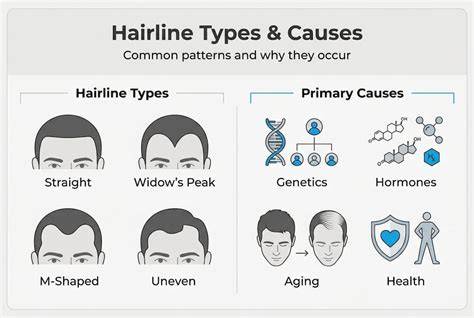
Have you looked in the mirror or at a recent photo and noticed that one side of your hairline appears higher than the other? You may be asking yourself, “why is my hairline uneven?” This is more common than you think - many men and women experience it to some degree. A hairline with an uneven appearance can result from aging, genetics, or male pattern baldness. An uneven hairline is exactly what it sounds like - your hairline is higher, thinner, or receding on one side of your head, creating an asymmetrical look.
Genetics play the biggest role in determining your hairline shape. If uneven or receding hairlines run in the family, you may experience similar patterns. Male pattern baldness (androgenetic alopecia) typically begins at the temples and can progress unevenly. Hair damage can contribute to hairline changes. Temporary shedding (telogen effluvium) triggered by stress, illness, hormonal changes, or certain medications can thin one side more than the other.
What can cause an uneven hairline in women?
An uneven hairline can arise from several factors, including genetics, hormonal changes, aging, styling habits, and medical conditions. In women, thinning can occur at the crown or along the part, and the front hairline may stay relatively intact for longer. Traction alopecia from tight hairstyles or extensions can create apparent asymmetry, especially around the temples and part line. Other conditions like frontal fibrosing alopecia (FFA) cause front and side hair loss and are typically permanent.
Frontal fibrosing alopecia (FFA) is a form of scarring alopecia that often affects postmenopausal women and may cause a shiny, hairless band along the front and sides of the scalp. Trichotillomania, a psychological condition where hair is repeatedly pulled, can also create uneven hairlines by causing breakage along the hair shaft. Hormonal changes, such as menopause or polycystic ovary syndrome (PCOS), can influence hair loss patterns and contribute to an uneven look.
Aging naturally slows hair growth and can cause some hairs to miniaturize, leading to a receding appearance that some notice more on one side. Medical conditions (thyroid disorders, autoimmune diseases, nutritional deficiencies) and medications can contribute to shedding or thinning on one area more than another. Hairline changes may also be temporary (telogen effluvium) or permanent, depending on the underlying cause.
Signs that your uneven hairline may require medical evaluation
Consider seeing a dermatologist if you notice a sudden change in hairline symmetry, patches of patchy hair loss, redness or flaking of the scalp, or hair shedding that seems out of the ordinary. A doctor will review your medical history, examine your scalp, and may perform a pull test, scalp biopsy, or blood tests to rule out infections, thyroid problems, or hormonal imbalances. They can help determine whether the cause is androgenetic alopecia, FFA, traction alopecia, trichotillomania, or another condition.
Strategies to manage and disguise an uneven hairline
Changing your hairstyle can help disguise an uneven hairline. Side parts, layers, and textured styles can create a more balanced look, while avoiding tight hairstyles prevents further frontal hair thinning and asymmetry.
Choosing shampoos, conditioners, and treatments designed for thinning hair can strengthen strands and reduce breakage. Avoid harsh chemicals that weaken hair or irritate the scalp, which can worsen unevenness.
Understanding how diet affects hair loss is crucial, as healthy hair starts with a balanced diet rich in iron, protein, and essential vitamins. Reducing stress can also help prevent temporary shedding, known as telogen effluvium.
Medical treatments and procedures
Minoxidil is a topical treatment that can stimulate growth in thinning areas of the hairline. Applied directly to the scalp (usually twice daily in liquid or foam form) it can gradually improve density.
A hair transplant may be considered for severe asymmetry or permanent hair loss. This is often an option when follicle damage, scarring, or pattern baldness prevents natural regrowth. Hairline transplants can be an effective solution for restoring a balanced hairline, but it’s important to evaluate whether it’s the right option for you carefully. Both FUE (Follicular Unit Extraction) and FUT (Follicular Unit Transplantation) can be used to correct an uneven hairline.
Medications may help slow or stop hair loss. Topical minoxidil, oral finasteride, and anti-androgen therapies can be part of a treatment plan, though prescriptions and suitability depend on individual factors. Some women may benefit from spironolactone or other anti-androgen medications, always under medical supervision, especially if pregnancy is possible.
Taking a broader view: recognizing patterns and common scenarios
In men, a receding hairline often begins above the temples and progresses to form an M-shaped or widow’s peak pattern, with thinning at the crown. In women, hair loss typically starts with the part and may widen the part or cause thinning at the crown while the frontal hairline remains relatively intact. Frontal fibrosing alopecia presents differently, with a more uniform recession along the front and sides, often after menopause.
There are various pathways to addressing a receding hairline in women, including lifestyle changes, medical treatment, and cosmetic options. For some, a non-surgical approach can effectively slow progression and improve appearance, while others may consider surgical options to restore a more balanced hairline.
Living with hairline changes and finding support
Living with a receding hairline can be challenging, because it affects your appearance and may affect other aspects of your health. Building a support system, talking with a dermatologist, and exploring styling options can help. Support groups and counseling can be beneficial for emotional well-being, especially for those experiencing distress related to body image or gender-related concerns.
For transgender and nonbinary individuals, hormone therapy can influence hair loss patterns, and care should be coordinated with a dermatologist and other healthcare providers to tailor an appropriate plan. As with any medical issue, early consultation improves the range of options and potential outcomes.
Key takeaways
- An uneven hairline in women can arise from genetics, hormonal changes, aging, styling habits, infections, or autoimmune conditions.
- Treatments range from lifestyle adjustments and topical products to medications and surgical options, depending on cause and severity.
- Professional evaluation is important to distinguish benign patterns from conditions requiring targeted therapy.
What HAIR LOSS Says About Your HEALTH: Top 15 Causes of Hair Loss (Doctor Explains)
If you’re concerned about a receding hairline or thinning hair, don’t hesitate to contact a hair loss specialist to discuss diagnosis and options. The right approach can slow progression, improve density, and help you regain confidence.