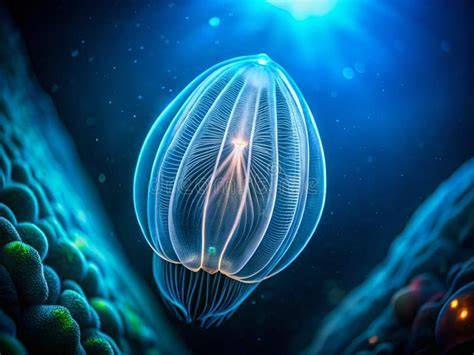
The comb jelly is a beautiful, oval-shaped animal with eight rows of tiny comblike plates they beat to move through the water. As a comb jelly swims, their comb rows break up light to produce a shimmering rainbow effect.
Natural history
A jelly is a gelatinous creature with few specialized organs. Most jellies locate food by detecting chemical traces in the water.
Bioluminescence and photoproteins
Comb jellies' ability to generate light comes from genes that produce photoproteins. Two types of chemicals involved in light production, called luciferin and luciferase, are bound together in a photoprotein. This molecule can be triggered to produce light when calcium is added to the system. Photoproteins emit flashes of very bright light for a fraction of a second. In the animal, this can translate to an impressive display of lights that run up and down the animal.
Researchers found that light-emitting photoproteins were located in the same cells as opsin genes, the most primitive type of light detector in animals. All animals use opsins to catch photons of light, and finding a functional opsin in a ctenophore indicates that they have been preserved throughout animal evolution. The co-localization of the opsin genes and the photoproteins may confer an advantage to the animal: it might be a feedback mechanism that allows the comb jelly to maintain the right amount of bioluminescence or it may enhance reproductive or defensive capabilities, Dr. Schnitzler suggested.
Evolution and genome insights
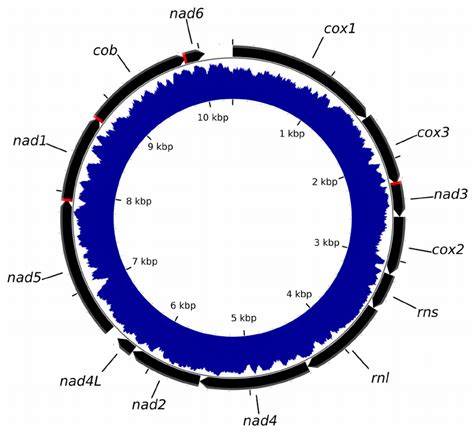
Comb jellies, also known as ctenophores, evolved more than 500 million years ago. They're among the earliest metazoans, a group comprised of all multicellular animals. Mnemiopsis leidyi, a representative comb jelly, lives off the eastern seaboard, from Maine to Florida, and is found in all oceans of the world. The study of Mnemiopsis leidyi based on its whole genome sequencing and annotation was conducted by Dr. Andy Baxevanis and his group in the Genome Technology Branch of the National Human Genome Research Institute (NHGRI). They based their findings on the whole genome of Mnemiopsis leidyi, which the group recently sequenced, assembled and annotated. Dr. Baxevanis and his group will soon publish a study analyzing the organism's genome, the first bioluminescent animal and the first ctenophore species for which there is a whole genome sequence.
“Comb jellies are quite beautiful,” said Christine E. Schnitzler, Ph.D., the paper's first author. “When light reflects off their cilia, it creates a rainbow of colors. But that's not the same as bioluminescence, which you can only see in the dark.”
Bioluminescence and multiple photoproteins
They didn’t expect to find photoproteins in comb jellies, and they didn’t expect to find 10 different photoproteins that were clustered into two groups in the genome. The researchers think that having multiple photoprotein genes allows the animal to produce larger amounts of photoprotein and emit more light quickly. “These protoproteins were tandemly arrayed, meaning that they were arranged one after another,” Dr. Schnitzler said. “This is fascinating for an evolutionary biologist because it means that these photoproteins somehow evolved as a group.”
Bioluminescence, vision, and sensory integration
Opsins are also located near the apical sensory organ, which is opposite the mouth. An apical sensory organ contains large sensory cilia that help it maintain proper vertical orientation or change swimming direction. The co-localization of light-emitting photoproteins and opsin genes suggests a potential functional link between light production and light detection, offering clues about the evolution of vision in early animals.
Ecology and conservation considerations
Comb jellies are found in all oceans of the world and have recently invaded the Black, Caspian and Baltic Seas, where they are considered pests because they consume fish larvae. Jellies are very sensitive to water quality at certain points in their lifecycle, making environmental health a key factor in their populations. This sensitivity underscores the importance of monitoring marine ecosystems to understand jellyfish dynamics and their potential impacts on fisheries and biodiversity.
Interesting facts
- A maximum length of five inches makes comb jellies among the largest animals to use cilia for locomotion.
- Natural light from light-reflecting cilia creates a rainbow effect, while true bioluminescence relies on photoproteins activated by chemical cues.
- The early evolution of photoproteins and opsins in ctenophores provides a window into how vision-related proteins arose and diversified in animals.
Potential implications
Bioluminescent sea creatures that emit and detect light are providing clues to the evolution of sight and may, in time, shed light on our understanding of eye diseases. By studying how photoproteins and opsins co-localize and interact in comb jellies, researchers hope to gain insights into primitive light-detection systems and their development across the animal kingdom.
a short lesson on the COMB JELLY
tags: #bioluminescent #comb #jellyfish