Cowlicks seem to have a mind of their own and like to go against the flow. The hair on your head needs to go in three directions -- some needs to go forward, some backwards, and some to the sides. In a perfect world, there would be a line so hair would know which way to go, says Dr. Orr Barak, a dermatologist at Tufts Medical Center in Boston. A cowlick is the body's answer to this, by having a centralized location on your scalp -- a crossing point for hair to grow and lie in different directions. But an unruly cowlick often selects its own direction -- and pops straight up -- or chooses an angle at odds with your preferred style.
A cowlick's spiral pattern is likely caused because hair gets confused about whether it needs to go forward, backward, or to the side, and some hairs get caught in between creating that characteristic whorl, explains Barak. Cowlicks were supposedly named for the swirling pattern made on hair when a cow licked its calves. Virtually everybody has a cowlick or two, with the most visible one found at the crown of the head and a second less obvious one, perhaps at the neck or on the front hairline by the part. They form early in life -- in utero -- and once you have a cowlick, you're stuck with it unless you lose your hair.
Both men and women are equally affected by them, although it doesn't seem that way since they are more noticeable in guys because they typically have shorter hair. Longer styles often camouflages a cowlick because the weight of the hair covers it up. And it's more obvious in straighter hair compared to curly. According to Barak, there are some interesting associations between cowlicks and their rotating patterns on your head. He says that noted geneticist Amar Klar has found a connection between handedness and the direction of hair whorls. In people who are right handed, at least 90% of cowlicks have a clockwise rotation while about 10% go in a counterclockwise direction. Klar's research has found that people who are not righties are more likely to have a counterclockwise cowlick. In one experiment, he found that 50% of folks who are lefties or ambidextrous have a counterclockwise whorl pattern, suggesting that hand preference and cowlick rotation may develop from a common genetic mechanism. Interestingly, in a study published in 2004 on nearly 600 men, Klar found that roughly 30% of gay men had a counterclockwise rotation on their scalp hair whorl compared to just 9 percent seen in the population at large.
In a practical sense, no matter how your cowlick swirls, most people would be happy to know how to tame it. Although Barak is a doctor and not a hair stylist, he recommends keeping your hair long or going with the grain of the cowlick. Cowlicks can be one of the most stubborn hairstyling challenges to deal with- no matter how much you brush or how many products you use, that one section of hair just refuses to stay in place!
What Is a Cowlick? A cowlick is a section of hair that grows in a different direction from the surrounding strands, creating a distinct swirl, lift, or tuft that often resists traditional styling techniques. Cowlicks often stand out from the rest of the hair and can be particularly challenging to tame, especially in shorter hairstyles. They are very common and can appear in different areas of the scalp. The most frequent locations include hairline cowlicks, crown cowlicks, and nape cowlicks, which can interfere with bangs, create a noticeable whirl, or flip outward in short styles.
What Causes Cowlicks? Cowlicks are primarily hereditary - if one or both of your parents have a cowlick, chances are you will too. This is due to the natural growth patterns of hair follicles, which are determined at birth. Hair whorls are caused by the way hair follicles are positioned beneath the scalp, which causes the hair to emerge at an angle. Fine, straight hair tends to show cowlicks more prominently because it lacks the weight to keep the hair down. Curly or coarse hair can help mask the effects of a cowlick by blending different growth directions. Cowlicks can also become noticeable as hair thins with age or due to density changes.
How to Style & Manage Cowlick Hair: Cowlicks are a natural part of hair growth. They’re harmless and tend to be permanent, but they can be effectively managed with the right styling techniques, haircuts, and products. Blow-drying techniques can manipulate direction; use a round brush and apply gentle tension, with a nozzle attachment and a final cool air blast to lock the style. The right haircut can make a cowlick less noticeable-layered cuts or textured bangs help blend the swirl into the hair. For crown cowlicks, add texture at the crown; for nape cowlicks, keep slight length at the nape or use a tapered/feathered cut to blend. If you prefer ultra-short hair, a buzz cut can minimize the effect of a cowlick in some cases.
Best Hair Products for Cowlicks include matte pomades or waxes for short to medium hair, styling creams and serums for longer styles, a flexible hairspray, and hair thickening fibers to visually minimize separation. The aim is hold with flexibility to avoid stiffness while keeping the cowlick tamed. For long-term results, consider training the hair by using heat and cool settings during blow-drying to direct the hair in the desired direction. If a cowlick is especially stubborn, experimenting with part changes, braids, buns, or ponytails can uncover a style that naturally accommodates the growth pattern.
Can you get rid of a cowlick? No, cowlicks are caused by hair follicle direction and are largely genetic. However, styling and professional treatments can reduce visibility. In some cases, chemical treatments such as relaxers may temporarily alter growth patterns depending on hair texture and stylist guidance. For concerns about thinning or hair loss in relation to cowlicks, consult a professional who can assess coverage options and growth patterns. Bosley’s hair restoration solutions offer options such as hair transplantation for persistent cowlicks, low-level laser therapy (LLLT), and scalp micropigmentation (SMP) for a non-surgical approach to appearance and density, particularly when thinning accompanies cowlick visibility.
Images and diagrams can illustrate common cowlick locations and growth directions for better understanding.
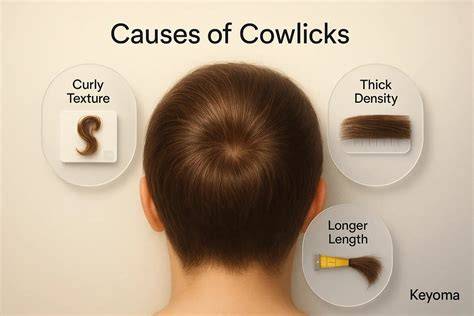
Historically, cowlicks have appeared in the front hairline, crown, and nape, with notable public figures having prominent examples at the hairline. The presence of cowlicks does not indicate hair loss by itself, but thinning hair can make them more noticeable. Understanding your cowlick’s direction and growth pattern helps tailor styling choices, haircuts, and products to achieve a smooth, controlled look that lasts throughout the day.
What to remember for everyday styling:- Train the hair with blow-drying against the natural growth direction using a round brush.- Use a heat-protectant and lightweight formulas to avoid weighing hair down.- Consider part adjustments, textures, or longer lengths to camouflage cowlicks.- When needed, explore professional options such as targeted hair transplants, LLLT, or SMP to address density and visibility.
In the end, cowlicks are a normal part of human hair growth. With the right approach, they can be managed effectively, turning a potential styling frustration into a predictable part of your hair routine.