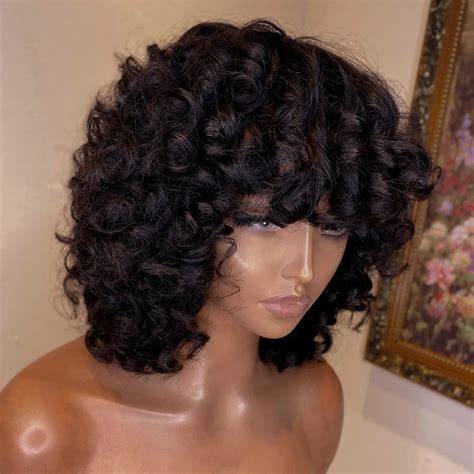
A curly wig with bangs blends soft curls with a face-framing fringe, creating a balanced style that feels both modern and timeless. Crafted entirely from premium human hair, a curly wig with bangs delivers natural shine, authentic curl definition, and a lightweight feel. Advanced lace technology plays a key role in realism. Options such as the UNDETECTABLE LACE WIG and LACE FRONT WIG are designed to create an invisible hairline, making the curls and bangs appear as though they grow naturally from the scalp.
A curly wig with bangs is highly adaptable. It can be shaped into a sleek BOB WIG for a refined, minimalist aesthetic or styled as a bold COLORFUL WIG for those who enjoy expressive looks. For convenience-focused routines, many customers alternate between a HEADBAND WIG and a U-PART WIG, depending on lifestyle needs. iDefineWig is recognized for its expertise in human hair textures, including straight wigs, wave wigs, deep curly wigs, and loose deep wigs. Every curly wig with bangs reflects the brand’s commitment to curl definition, balanced density, and long-term wearability.
To expand styling possibilities, customers often complement their main piece with another UNDETECTABLE LACE WIG or experiment with different parting options through a 4X4 LACE WIG. A curly wig with bangs can make the front edge easier to manage, but the fringe still has to look as though it belongs to the rest of the wig. The most convincing options usually get four things right: cap fit, density, crown shape and the transition from bangs to curls.
I’d judge the fringe before the color. If the bangs look disconnected from the crown, even a beautiful curl pattern will struggle to rescue the front. Look for bangs that break into natural-looking pieces, continue into the temple curls and leave enough room for adjustment. Be wary of a very thick shelf of hair, a puffed-up crown or a listing that shows one immaculate front view and absolutely nothing from the side. Studio lighting is helpful. It can also be a talented little liar.
Which Type of Curly Bangs Should You Choose?
Choose the effect you want rather than treating face-shape rules as law. Our hairstyle-by-face-shape guide can help you compare visual proportions, but forehead coverage, glasses, part placement and your preferred amount of volume are more useful starting points for a wig.
- Full curly bangs - Covers most of the forehead and can conceal the front edge of a basic cap. Make sure the fringe is not much denser than the side curls or cut into one heavy, blunt block.
- Wispy curly bangs - Keeps the front lighter and lets more skin show through. The hairline, roots and crown need to look believable because the fringe provides less coverage.
- Curtain bangs - Opens the center of the face and blends into longer side pieces. Check that the part looks realistic and that both sides fall into the main curl pattern.
- Side-swept bangs - Creates an off-center shape and offers more flexibility around the forehead. Look for enough length to sweep the fringe without exposing a hard front edge.
If curtain fringe is the look you are considering, our guide to curtain bangs for curly hair can help you compare lengths and shapes before you shop. The styling methods will differ on a wig, but the visual references are still useful.
What Makes a Curly Wig With Bangs Look Natural?
No single feature makes a wig look natural. The fringe, crown and cap have to work together. The fringe should connect to the rest of the wig. Study the point where the bangs meet the temples and crown. The transition should look gradual, with a few curls bridging the shorter fringe and longer lengths. A severe gap can make the bangs look like a separate piece attached to the front. The curl direction matters too. Identical rows can look overly set; slight variation usually reads more naturally. Density should make sense from front to back. Thin is not automatically natural, and thick is not automatically fake. The density needs to make sense across the style. Sparse bangs against extremely full lengths can expose the construction; dense bangs under a bulky crown can create the “helmet” effect shoppers worry about.
I pay close attention to the top and side views. Jon Renau’s guide to wig density shows how cap construction can make a hand-tied style lie flatter and move differently from a wefted one.
Read the Listing Beyond the Glamour Photograph
Before buying, check for:
- A front view in ordinary light
- Both side profiles
- A clear crown or parting view
- Video showing how the curls move
- Customer photos taken in ordinary light
- Exact fiber and cap-construction details
- Bang length as well as overall length
- Available cap sizes and the brand’s measurement chart
- Return conditions for cut lace, removed tags, washing or styling
Customer videos are particularly useful because movement reveals what a posed photograph can hide. Watch the crown as the wearer turns. Look for sudden bulk, visible cap material or a fringe that separates from the side curls. Do not rely on the product name alone. “Glueless,” “beginner friendly” and “pre-styled” do not tell you whether the cap will fit. Texture names such as water wave, Jerry curl and kinky curly are useful search filters, but compare the actual curl size and root pattern in photographs because labels are not a substitute for seeing the wig.
I would leave a listing behind if it gives no useful measurements, does not identify the fiber or cap construction, hides the crown in every photograph, or makes the return conditions difficult to find.
Does a Wig With Bangs Need a Lace Front?
Not always. Full bangs can cover the front edge, so paying extra for a lace front may be unnecessary if you never plan to expose the hairline. The lace front may be less important for someone who prefers bangs or fringe. The right construction depends on what the style reveals.
| Cap Feature | Best Use | Tradeoffs |
|---|---|---|
| Basic or open-wefted cap | Full bangs cover the front and breathability or budget matters | Parting flexibility may be limited; crown may look fuller |
| Lace front | Wispy, curtain or side-swept bangs may expose the front hairline | Lace is delicate and does not correct poor sizing |
| Monofilament top or part | The fringe opens enough to show the part or crown | Generally a premium construction; higher cost |
My rule is simple: pay for the construction you will actually see or benefit from. My buying verdict for a first curly wig with bangs is to choose slightly longer fringe, balanced rather than extreme density, clear photos from several angles, exact cap measurements and a return policy I can understand before checkout. If two wigs look equally appealing, buy the one that gives you better information.
- Cap fit determines where the bangs land; measure circumference around the hairline and nape, front hairline to nape, and ear-to-ear over the top.
- Compare with the brand’s sizing chart because sizing can vary.
- Set the wig in its final position before judging the fringe; adjust if needed.
- Decide whether to adjust, return, or choose another construction based on comfort and realism.
For practical reshaping, a professional wig stylist may be helpful, as curly fringe can spring shorter than expected. Headcovers also recommends cutting bangs while the wig is being worn and choosing a stylist familiar with wig customization. If you plan meaningful reshaping, consult a professional who understands curls and wig construction.
In summary, for a first curly wig with bangs, aim for a balance of fringe length, density, and realistic cap construction, with thorough visual references from multiple angles and clear policy terms before purchasing. If two wigs look equally appealing, choose the one that offers better information and fit for your lifestyle.