Minoxidil is a medication used primarily to treat hair loss, specifically androgenetic alopecia, which includes male and female pattern baldness. It is available over-the-counter in topical forms such as liquids and foams, commonly in 2% and 5% concentrations. Minoxidil was originally developed as a treatment for high blood pressure, but its side effect of promoting hair growth led to its repurposing as hair loss treatment.
During clinical trials in the 1970s, researchers discovered that one of its side effects was excessive hair growth, known as hypertrichosis. This unexpected outcome led to further investigation into its potential as a hair loss treatment. By the 1980s, Minoxidil had been reformulated for topical use to combat hair loss and was FDA-approved in 1988 as the first drug proven to promote hair regrowth. Today, it is still used for lowering blood pressure in specific cases, but there are currently better medications for blood pressure control. It was observed that patients using minoxidil for hypertension were experiencing an increase in hair on their scalp and their body, which led to the association between minoxidil and hair physiology and the development of a topical formulation approved for hair loss in men and women.
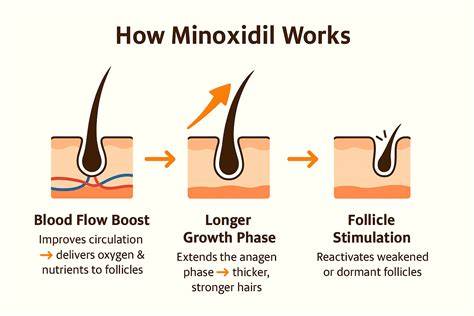
There is a long-standing view that Minoxidil is one of the oldest and most effective tools in treating hair loss, though its exact mechanism of action is not fully understood. It lengthens and prolongs the anagen (growth) phase of the hair cycle, decreasing hair loss and thickening hair overall. For topical effectiveness, minoxidil must be metabolized to minoxidil sulfate; skin and liver enzymes perform this conversion, with significant individual variation in skin across people and scalp areas. When taken orally, conversion occurs in the liver, providing more consistent minoxidil sulfate levels and often greater effectiveness. Minoxidil sulfate relaxes smooth vascular muscle, promoting vasodilation and increased scalp blood flow, which may contribute to hair follicle growth. It has also been shown to stimulate production of certain growth factors, aiding hair proliferation, though the full mechanism remains not completely understood.
Formulations and applications have evolved over time. Topical 5% minoxidil is recommended for men and 2% for women to minimize facial hair growth; patients are usually advised to apply it twice daily to the scalp. Women may see better results with 5% topical minoxidil when used once daily. Side effects of topical minoxidil commonly include skin irritation, redness, and dryness due to propylene glycol; a foam formulation without propylene glycol reduces irritation and grease, and it melts with body heat for better skin contact. Liquid formulations can lose product to the hair shaft rather than reaching the scalp. In recent years, there has been a notable increase in prescribers using oral minoxidil, which tends to be more effective than topical in some cases but carries risks of dizziness, tachycardia, and increased facial and body hair. Combined therapy, such as minoxidil with finasteride and laser treatments, is often used for androgenetic alopecia because the treatments target hair follicles differently and can be more effective together than alone.
Topical minoxidil is usually applied to the scalp twice a day for men and once a day for women, across the entire scalp including temples and the anterior hairline. Oral minoxidil dosing varies from 0.625 mg to 5 mg per day, with considerations for age, other medications, and cardiovascular history. Side effects differ by route: topical minoxidil commonly causes scalp irritation; oral minoxidil can cause palpitations, dizziness, hypotension, chest pain, and swelling of the legs. People with scalp conditions like psoriasis or seborrheic dermatitis may experience more irritation. Older patients and those with heart issues should consult a physician before starting oral minoxidil. When combining minoxidil with other treatments (e.g., finasteride or laser therapy), the goal is to maximize efficacy while balancing safety.
Purchasing and regulation vary by country. In the United States, 5% topical minoxidil is available over the counter, with higher concentrations sometimes prescribed or compounded by pharmacies. Oral minoxidil is prescription-only in the U.S. and is more likely to be used in specialized cases, often at lower doses in women to reduce the risk of unwanted body hair growth. Important questions arise about permanence: Minoxidil requires ongoing use to maintain results; cessation generally leads to a return to baseline hair loss over time, though hair loss may not immediately worsen beyond normal progression. It is also possible for body hair growth to occur when using oral minoxidil, especially at higher doses, which is a common concern among patients using this therapy. In cases where body hair growth is problematic, management options include dose adjustments, supplementary therapies, or cosmetic hair removal techniques such as laser, waxing, or electrolysis.
When considering Minoxidil, a correct diagnosis by a dermatologist or trichologist is advised to select the most appropriate treatment plan. For those seeking guidance on hair restoration options, tools like a Find A Doctor resource can help locate ISHRS members by location.
How Minoxidil Works: Mechanisms and Variability
Minoxidil lengthens the anagen phase and increases hair follicle proliferation, with minoxidil sulfate driving vascular changes and growth factor production. The skin's sulfotransferase enzyme governs topical activation, which explains inter-individual differences in efficacy. Orally, the liver provides a more consistent activation, potentially increasing effectiveness but with a greater risk of systemic side effects. Be aware that the exact mechanism remains not fully understood, but the observed outcomes-thicker hair, slower shedding-are well documented in studies and reviews.
Formulations, Dosing, and Safety Considerations
Topical minoxidil-5% for men, 2% for women-should be applied to the scalp twice daily for men and once daily for women; foam formulations are often better tolerated due to lack of propylene glycol and improved scalp delivery. Oral minoxidil dosing ranges from 0.25 mg to 5 mg daily; higher doses convey higher efficacy but raise the risk of side effects such as hypotension, edema, and unwanted body hair growth. Before starting oral minoxidil, discuss cardiovascular history, potential interactions, and monitoring plans with a physician. Common topical side effects include redness, irritation, and dryness, especially in those with sensitive or irritated scalps. Regular monitoring and tailored dosing are essential to balance efficacy with safety.
Minoxidil is frequently combined with finasteride or laser therapy for androgenetic alopecia to enhance results. In women, 0.25 mg oral minoxidil combined with spironolactone has been suggested as a strategy to maximize hair-promoting effects while minimizing hypertrichosis, though spironolactone can have its own risks and contraindications. Patients should be prepared for possible increased body hair with oral minoxidil, particularly at higher doses, and should discuss cosmetic management options if this occurs.
Practical Guidance for Patients
- Apply topical minoxidil as directed, focusing on the scalp; avoid applying to the hair shafts.
- Be aware that hair growth may take several weeks to months to become noticeable and may require continued use to maintain results.
- If body or facial hair growth is a concern with oral minoxidil, discuss dose adjustments or alternative therapies with your clinician.
- Do not stop oral minoxidil abruptly without medical guidance, as hair typically regresses over time after discontinuation.
- Consult a dermatologist or trichologist for a precise diagnosis and personalized treatment plan, particularly if you have cardiovascular concerns or are considering combination therapies.
FAQ Highlights
- Is Minoxidil permanent? No; results require ongoing use, and stopping typically leads to loss of gained hair over time.
- Can I comb my hair after applying Minoxidil? Yes; apply to the scalp, not the hair shaft, and combing after application is not a problem.
- Is beard hair growth permanent? Hair gains from Minoxidil may diminish after stopping treatment; beards may regrow elsewhere depending on the treatment and usage.
- Can I leave Minoxidil on overnight? Yes; topical use is usually twice daily for men and once daily for women.
- What if Minoxidil touches the face? It can promote hair growth in non-scalp areas; wash hands and avoid facial contact after application, especially for women to minimize systemic absorption.
- Is Minoxidil a steroid? No, it is not a steroid.