A lot of people notice their hairline pulling back at the temples and wonder whether it has always looked that way and is simply part of their face, or whether hair loss is starting. There is no medical condition called a congenital receding hairline. What you are born with is only the shape and height of your hairline. In women, two more causes come into play: temple hair loss from the pull of tight hairstyles (traction) and scarring frontal fibrosing alopecia.
“In medical terms, a congenital receding hairline does not exist as a diagnosis. What is inherited is only the shape of the hairline. Is a Receding Hairline Genetic? Inherited or Hair Loss? Is a Receding Hairline Genetic?” Strictly speaking, receding temples are rarely something you are born with. What you inherit is the shape and height of your hairline, set by polygenic inheritance, meaning many genes each with a small effect. So two things need to be kept apart. First, the inherited hairline shape: some people naturally have a higher, more angular hairline or a widow’s peak. That shape is stable and barely changes. Androgenetic alopecia is genetic too, but it is a progressive process that pushes the hairline back at the temples cycle after cycle.
One honest note on inheritance: the old textbook myth that baldness comes only from your mother’s father has been disproven. Twin studies point to a heritability of around 80 percent, and the pattern is polygenic. The androgen receptor gene locus does explain a large share of the risk, but both sides of the family contribute. Babies and toddlers do not have a genuinely receding hairline. The wedge-shaped contour on an infant’s forehead is a hairline that is still forming, plus the normal newborn hair shedding. A widow’s peak is an inherited hairline trait with no medical significance.
Whether receding temples are inherited or a sign of hair loss comes down mostly to time. An inherited or mature hairline stays stable and symmetrical for years. The mature hairline is a normal step in growing up. The straight childhood line usually moves back evenly between the ages of 17 and 30, by about half an inch (1 to 1.5 centimeters), and then stops. Early androgenetic alopecia, by contrast, has no natural stopping point. Its hallmark is miniaturization of the hair follicles: strong terminal hair turns into fine, short, pale vellus hairs.
The checklist below is a rough guide, not a diagnosis. A second clue that often gets overlooked is the pace. It is not the height of the hairline that matters, it is the movement. Since comparing photos over time is the most reliable thing you can do on your own, it is worth doing it properly. Poor photos with changing light or angles only create the illusion of change. If the line moves measurably against your reference point, that points to a progressive process.
Receding temples in the teenage years, usually from around 16 to 18, are, in the vast majority of cases, simply the hairline maturing, and they affect a large share of young men. The shift from the straight childhood line to the more angular adult shape is a hormonal step in puberty, not hair loss. It is completely understandable that a receding hairline hits especially hard and causes worry at that age. That is exactly why a sober assessment matters: panic is usually unfounded here. Even so, pattern hair loss can start early. Studies on the adolescent form report very different frequencies depending on definition and population, from under 2 percent to over 15 percent.
What matters is the takeaway: genuine, clearly advancing recession with thinning before age 20 points to early-onset androgenetic alopecia and is a reason to get a dermatologist involved now instead of waiting. The temples recede first because their hair follicles are genetically especially sensitive to the hormone DHT (dihydrotestosterone). DHT makes sensitive follicles shrink, while the follicles at the back of the head stay largely DHT-resistant. The chain of events, in short: the enzyme 5-alpha-reductase converts testosterone into DHT. DHT binds to the androgen receptor in follicle cells about five times more strongly than testosterone does. Sensitive follicles then shorten their growth phase and miniaturize.
That explains both mix-ups at once: the sensitivity is inherited, but the hair loss only happens once enough DHT has acted for long enough. One important caveat: this DHT mechanism at the temples describes the male pattern. In female pattern hair loss, DHT is often not the only driver, and the front hairline usually stays intact. More on women in a moment.
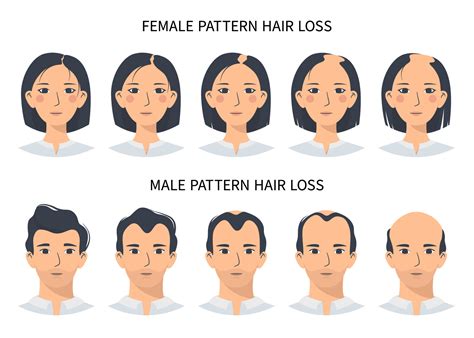
A receding hairline in the classic male M shape is rare in women. Female pattern hair loss usually shows up as diffuse thinning around the part line with the front hairline preserved (Ludwig pattern). In women it is harmless when the hairline naturally sits higher or shows a widow’s peak and has been stable since the teenage years, with no thinning. Women should get a medical opinion on any new, progressive temple recession, visible thinning, or accompanying signs such as irregular periods, acne, or increased body hair.
So for a woman with receding temples, finding the cause comes before any self-treatment. A common and often overlooked cause of hair loss at the temples in women is traction alopecia. Constant pull from tightly bound styles such as ponytails, buns, cornrows, braids, extensions, or weaves weakens the hair along the temple and front hairline. Typical signs are thinning or bald strips along the areas under tension, plus fine remaining hairs at the very edge of the hairline, known as the fringe sign. In one clinical cohort it was present in around 90 percent of the patients examined. Timing is everything: the early stage is non-scarring and reversible once the pull is reduced, while the late, chronic stage scars and is irreversible. In practice that means reducing tension, looser styles, breaks from extensions. The earlier, the better the outlook.
Not every receding temple line is pattern hair loss or a harmless inherited trait. The mature or inherited hairline is stable and symmetrical, with no medical significance. Traction alopecia follows the pattern of the pull and is reversible early on. Frontal fibrosing alopecia (FFA) is a scarring form: the front and side hairline recedes in a band, often with loss of the eyebrows and pale, shiny skin along the edge. Eyebrow loss occurs in 64-94 percent of cases. One widespread misconception worth correcting: FFA does not only occur after menopause.
A vitamin or nutrient deficiency does not cause a congenital receding hairline. A deficiency produces diffuse shedding across the whole scalp, not wedge-shaped notches at the temples, and supplements will not fill those notches back in. A safety note: do not apply minoxidil on your own to an inflamed or scarring scalp (active FFA) or to areas under tension (traction). It can make the irritation worse and does nothing for these forms.
The first step with receding temples is not a product, it is the diagnosis: are you dealing with a harmless inherited hairline, traction, FFA, or pattern hair loss? That leads to a simple set of decisions. A stable, inherited hairline is not something you treat. Traction, FFA, or pattern hair loss require different approaches. If you see red flags, your first stop is always a doctor, not an online analysis.
If that medical check has already happened, or if it is purely a question of a stable versus a progressing pattern, a free hair analysis from Elithair can help with the visual assessment. A receding hairline is not a congenital medical condition; what is inherited is the shape and height of the hairline. Do babies or toddlers already have receding temples? No, babies and toddlers do not have a genuinely receding hairline. The wedge-shaped contour on an infant’s forehead is a hairline that is still forming, and part of the normal newborn hair shedding. A widow’s peak is an inherited and harmless trait.
How to Tell If It’s Inherited or Hair Loss
The decisive factor is what happens over time. An inherited or mature line stays stable for years and is largely symmetrical. A progressive recession gets measurably deeper and shows fine, miniaturized hairs. Can a receding hairline be asymmetrical? Slight natural asymmetry is normal and harmless. Hardly any face is exactly symmetrical, and a cowlick can also make one side look a little different.
Who do you inherit a receding hairline from, your mother or your father? A receding hairline is inherited from both sides of the family. The inheritance is polygenic, spread across many genes. Which vitamin deficiency causes a receding hairline? None. A receding hairline can be due to inherited or pattern recession, not a vitamin deficiency. A receding hairline at 16 or 17, is that normal in your teens? In the vast majority of cases it is normal-the hairline is maturing. Can a teenager already have pattern hair loss? Yes, but most temple changes in adolescence are the harmless maturing process.
Do women get receding temples too, and why do they look different? Women rarely get the classic M shape. Female pattern hair loss usually shows up as thinning around the part line with the front hairline preserved (Ludwig pattern). Why are my temples receding as a woman? Several causes are possible: pull from tight hairstyles (traction alopecia), scarring frontal fibrosing alopecia, a pattern type, or diffuse shedding. Hair loss at the temples from ponytails or extensions, is that traction alopecia? It can be traction alopecia. Early on, the loss is reversible once the tension is reduced.
Does an inherited receding hairline mean you will go bald? A stable, inherited hairline is not a sign of baldness to come. Can an inherited receding hairline grow back in? An inherited hairline shape does not change and does not grow back in, but it has no medical significance either. When should I see a doctor about receding temples? With very rapid loss, round patchy bald spots, redness or flaking, loss of the eyebrows, clearly receding temples in a woman, or hair loss with other symptoms.
Causes and treatments overview: Genetics (Androgenic Alopecia), Traction Alopecia, Frontal Fibrosing Alopecia, and telogen effluvium. The approach is to determine the type, then choose appropriate management. Treatments like minoxidil and finasteride are discussed for adults; for teens, careful medical supervision is essential. A dermatologist can perform dermatoscopy, run labs, and provide an evidence-based plan.
What about prevention and management in teens? Manage stress, ensure adequate nutrition (iron, zinc, biotin, vitamin D, protein), consider scalp care, and choose hairstyles that reduce tension. PRP, laser therapy, and hair transplantation have specific indications and age considerations. For teens, early evaluation can influence long-term outcomes.
- Stabilize or slow progression with medically supervised treatments if pattern hair loss is confirmed.
- Address reversible causes like traction with looser hairstyles and reduced pull.
- Consult a dermatologist for diagnosis and personalized plan; avoid self-treatment.
Is a receding hairline something you are born with? A receding hairline is not a congenital medical condition. What is inherited is only the shape and height of the hairline. Do babies or toddlers already have receding temples? No. The wedge-shaped contour on an infant’s forehead is a hairline that is still forming, and part of normal development. How do I tell whether my receding hairline is inherited or hair loss? The decisive factor is time: inherited hairlines stay stable, while hair loss shows measurable progression and miniaturization.
In summary: a stable, inherited hairline is not a sign of baldness to come, while progressive pattern recession is an early indicator of further hair loss. The course is individual: some stabilize early, others continue to progress. The first step is diagnosis, then treatment decisions follow, with a focus on the type rather than the treatment itself.
Применение и дополнительные детали
Timeline expectations: neither drug works fast. Minoxidil takes about three to four months to show initial response, and full effect takes a year. Finasteride's stabilizing effect appears at three to six months; density improvements take 12 months or more. You will shed more hair during the first six to eight weeks of minoxidil use. If progression continues after three to six months, finasteride may be added. For teens, safety and age-appropriate considerations are essential.
Tagnote: Этот текст содержит общие сведения и не заменяет медицинский диагноз.
Teenager with hair loss? - Is it one of these 6 different types
Key points for teens and parents: seek professional evaluation, verify age-appropriate treatments, and manage expectations. Regular follow-up and objective monitoring (monthly photos, for example) help track changes and guide decisions.