Tapers and fades are common cuts that many request at barbershops. Lots of people, even barbers, use these names interchangeably. Understanding the differences between these cuts is the key to communicating with your barber and getting the look you want.
What is a taper?
A taper is a cut that leaves your hair long at the top and short on the sides. Hair gradually gets shorter as you move down the back and sides of your head. Your hairline has the shortest part of your hair. Tapers are great if you want a classic look that doesn’t leave your hair too short. This cut also gives you room to try different styles as your hair grows out. A low taper is a cut that starts to get short above the ears. This cut gives your hairline a clean look without cutting off too much length. It’s also a great choice if you don’t want to expose your scalp. A high taper shortens hair a couple inches above the ears. The cut creates more contrast than a low taper. A taper or a fade can include a tapered neckline. Your neckline’s cut adds even more personality to your hair. You can get a design, disconnect, or a classic neckline shape. A tapered neckline will look the most natural when it grows out.
A skin taper is when the scalp is visible because hair is shaved close to the skin. You can get a skin taper with other cuts and other tapers. For example, you can get a high taper that tapers into the skin. It’s a practical cut to keep hair off your face when the weather warms up.
What is a fade?
A fade is a cut that also has hair go from long to short, but normally goes very short towards the bottom and fades into the skin. A typical fade gradually changes hair length all around your head. The change from long to short looks more dramatic with a fade than with a taper. Fades are also incorporated into many other haircuts. A low fade looks similar to a low taper since they both start above the hairline. The major difference is that a fade abruptly changes hair lengths. Drop fades are perfect when you want to steer away from the classic fade. A drop fade is a fade that drops below the ears and follows the shape of your head. This cut requires some maintenance to keep up the contrast as it grows out. A skin fade is also known as a bald fade. Like the skin taper, the skin fade shaves hair close to the skin, stopping before the natural hair line. You can get a skin fade while keeping the top of your hair long enough for a quiff or a pompadour. Undercut fades feature a blurry fade that’s normally cut high above your ears. This style looks especially great with long hair since you can show off the length differences. A faux hawk fade will definitely stand out because of its subtle height and length contrast. The high fade gives a fresh take to any style. A high fade starts a couple of inches above the ear and gets shorter as you go down. It also gives your barber lots of room to add designs.
How to choose between a taper and a fade
A taper or a fade can include a tapered neckline. Your neckline’s cut adds even more personality to your hair. The best cut for you depends on your face shape, style, and the look you want. A shaved or skin variant (skin taper or skin fade) can be practical in warm weather or when you want to keep hair off your face. A low taper or low fade offers a subtle transition, while a high taper or high fade provides more contrast and room for designs. Many hairstyles incorporate a taper as part of the overall cut, so you may end up with a taper without actively asking for one.
Combination cuts and practical notes
A taper fade is a barber term that popped up when people started to mix up tapers and fades. This isn’t a specific haircut or style. Comb overs were previously a practical style people used to cover up thinning hair. Today, a comb over is a fashionable cut that’s flattering for everyone. There are lots of variations you can try that have different lengths and shapes. Tapers and fades are both great styles to get for your next haircut. Start looking through photos to see what you’d like to try. Once you’ve narrowed down a few looks, find a local barber to get their opinion.
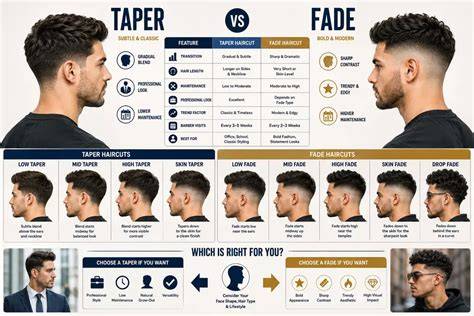
To help you visualize options, consider these common scenarios: a classic taper with a clean neckline for a timeless professional look, a high fade with long top for bold style, or a skin fade to pair with a quiff for a modern edge. Each choice can be adjusted by how quickly the hair shortens and where the hairline is shaped.