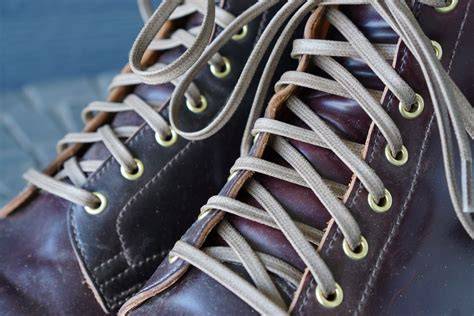
These are a pair of Chippewa service boots I wear periodifically. Since I don't wear them a lot, I hadn't waxed the laces yet. It's high time to give them the treatment. Have you ever bought a new pair of boots and noticed that the laces were sort of stiff. Like if you put a bend in them, or tied them, they stayed where they were and didn’t want to come undone? It’s probably because the laces were waxed. Many quality bootlaces do come waxed, and there’s quite a good reason for doing so. Much like a waxed cotton canvas jacket, waxed laces last longer and can prevent water damage. But if your laces don’t come waxed, is it worth it for you to wax your own? Here’s what I can tell you about waxing your bootlaces, whether or not it’s a good idea, and how you can do it at home.
In Favor of Waxing Your Bootlaces
First let’s cover the reasons you might want to wax your bootlaces. Like most things I will cover on this site, my focus here is on function and not form. This is all about performance. Whatever you use to wax your bootlaces, either beeswax, paraffin, or some commercially available treatment, wax will help keep water out of your bootlaces. This is beneficial, for a number of reasons. One is that both cotton and synthetic bootlaces are highly porous and absorbent. If they get wet, they will remain wet for a long time.
This is problematic for two reasons. One, it can encourage your bootlaces to rot, grow mold, or sustain other water-related damage. These laces are freshly pulled out of the hot wax. I can’t prove this next point, but it has seemed to me that waxed laces are more wear-resistant than bare laces. Bare laces will wear on rocks and briars as you trudge through the field. Over time, these will fray and the laces will fall apart.
While the previous point I cannot substantiate with hard evidence, this I can. The wax in laces helps give them memory. Where you put the laces, they want to stay, whether you kink, roll, fold or tie them. This is a boon to hikers and hunters that regularly traverse rough, tangled uplands and dense brush. More than one when I was upland hunting I had to stop what I was doing and retie my boots. The briars and brambles will untie your bootlaces for you quicker than you might imagine. Either way, waxing your laces gives them an extra hedge against the mischief of the ground cover.
So, knowing all of that, if your new boots came with bare cotton laces, maybe you want to wax them yourself. I use regular paraffin wax to treat my bootlaces. If you want to wax your bootlaces at home, or retouch an old pair of waxed laces with a fresh coat, all you need are a pair of laces, some paraffin wax (you can get this at most any hardware store or grocery store, where the canning supplies are) and a vessel that you can heat the wax in. I use Gulf Wax and heat it in an aluminum catering tray. You can also basically get these anywhere, too.
Safety and setup
The first step is shaving off some wax into your container. Thin shavings and little bits work best only because they melt much more readily. It will take you longer to heat big chunks and you don’t necessarily want this wax to be too hot. The hotter it is, the longer it takes to cool on the laces. This melted paraffin is ready to go. I advise strongly against doing this on the stove. It’s far too easy to overheat the wax and you don’t want to experience a flare up if you can help it. I’ll be using a conventional oven. Set the temp somewhere around 120℉ or 130℉ and don’t go anywhere; you’ll want to keep our eyes on this.
Once the wax is melted, remove it from the oven and place your laces in it. You want to just about submerge the laces in the wax and press them down with your fingers. Dunk the laces in the wax and give them a moment to let the fibers drink up some of the melted wax before removing them. Let them sit in the wax between 20 and 30 seconds, then slowly lift them out.
This is what boot laces look like after they have been waxed. Place one lace down on a paper towel and take the other one in hand, running the lace through your fingers to strip off the excess wax. You can place this in the container holding the wax. Repeat that process two or three times. By the end of it, there will still be some wax on the outside of the laces but that will flake off eventually. Place that lace down and repeat the process with the other one. This is what freshly waxed bootlaces look like. The color is a bit off, but once the laces shed the excess wax, they'll return more or less to their original color.
Place the laces somewhere where they can cool fully, then lace up your boots. A few things to note here; one is that it will be difficult to draw your laces through the eyelets. That’s normal. Another is that the freshly waxes laces will shed chips of wax as you lace the boots up, so if you’re concerned about getting wax on your floor, do this outside. Again, freshly waxed laces will look white or faded white. Don’t worry. All you need to do is put a few miles in your boots and the rest of the excess wax will flake off, and your laces will look more or less the color that they’re supposed to.
Infographic idea: comparison of waxed vs bare laces on water resistance and wear. A simple visual showing porosity, water beading, and durability could help readers quickly grasp benefits.
How to wax shoe laces.
In practice, waxing laces can extend life, improve handling, and aid in keeping laces tied in rugged terrain. If you’re preparing for outdoor work or hikes where weathers can be wet or brushy, waxed laces offer a practical advantage. The method described here aims to balance ease, safety, and effectiveness for at-home use. If your laces already come waxed, you may simply refresh them to restore performance; if not, this process can be a straightforward upgrade to your boots’ reliability.
| Step | Action | Notes |
|---|---|---|
| 1 | Shave wax into container | Thin shavings melt quickly |
| 2 | Heat wax | Oven at 120-130°F; avoid stove |
| 3 | Submerge laces | Fully cover; press down |
| 4 | Wait 20-30 seconds | Let fibers absorb |
| 5 | Remove excess | Wipe with paper towel |
| 6 | Repeat | Two to three passes |
| 7 | Cool and test | Expect some shedding |
So, if you’re contemplating waxed bootlaces for improved performance, the process above outlines a practical at-home approach. Freshly waxed laces may look lighter or white at first, but after wearing a short distance, they typically return to a more familiar color as the excess wax flakes away.