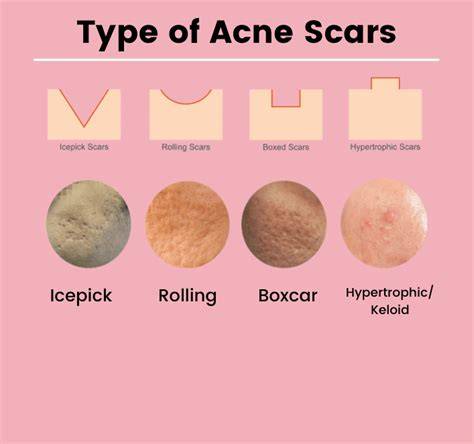
Some of us escape our acne-prone teenage years with our skin unscathed. However, some people with acne may find themselves dealing with acne scars. Acne begins with clogged pores that become filled with oil and dead skin cells. Bacteria can multiply within the pore causing inflammation, pustules and nodules. These lesions can resolve leaving marks behind. Even if you keep your skin clean and avoid touching blemishes, you can still develop acne scars. While their appearance may decrease over time, after about 6 months of healing acne scars will not improve further without intervention. We recommend seeing a dermatologist for acne and acne scars that make you self-conscious or affect your life.
What acne scars look like and why they form
Acne scars, especially on the face, often look like darkened or red blotches as well as small pits or indentations. These types of scars can be very difficult to treat. There are a number of different types of acne scars. They fall into one of the following categories: depressed (atrophic) scars including icepick scars, boxcar scars, and rolling atrophic scars, and raised (hypertrophic) scars. Dark spots (post-inflammatory hyperpigmentation) are not scars technically, but can be a visible reminder of acne. Hyperpigmentation can also be a temporary side effect of treatments for acne scars, especially in people with darker skin.
How long scars take to fade on their own
Acne scars do not go away entirely on their own. Depressed acne scars often become more noticeable with age as skin loses collagen. Post-inflammatory hyperpigmentation or redness may lighten on its own within several months, but for some people it may take years to go away without treatment. There’s no sure way to get rid of all acne scars, and different scar types require different approaches.
Overview of treatment options
Treatment shouldn’t be started until the acne has completely healed. A dermatologist can help determine the best plan based on scar type, skin color, and personal preferences. Treatments fall into several broad categories: in-office dermatological procedures, at-home or topical approaches, and, in some cases, surgical options. Here’s a closer look at the main options and what they aim to achieve.
In-office dermatological procedures
- Resurfacing procedures: Laser therapy, dermabrasion, microdermabrasion, and chemical peels remove layers of skin to encourage new cell growth. Some laser types may be safer for darker skin; Nd:YAG lasers are commonly mentioned as safer options for darker tones.
- Fillers: Dermal fillers can lift shallower scars to the level of surrounding skin. Results usually last a few months, though some fillers are permanent.
- Microneedling (collagen induction therapy): A microneedling pen creates micro-injuries to stimulate collagen production, helping with depressed scars. Multiple sessions may be needed.
- Radiofrequency skin tightening: This method can help treat deeper scars by tightening the skin and reducing visibility of depressions.
- Subcision: A needle is placed under the scar tissue to release fibrous strands and raise depressed scars.
- Injections: Corticosteroids or other medicines may be injected to flatten raised scars, with repeated sessions improving results.
- Surgery: Minor surgical techniques can reduce the appearance of depressed scars by lifting or breaking up scar tissue. Cryosurgery may be used for raised scars but is not usually recommended for darker skin tones.
Some treatments may involve downtime: dermal fillers often have minimal downtime, while lasers and chemical peels can cause redness or swelling for several days. The VBeam laser, for instance, can address red discoloration, and post-treatment redness may be camouflaged with tinted sunscreen.
At-home and topical approaches
Over-the-counter chemical peels and topical retinoids can improve scar appearance by promoting skin cell turnover and collagen production. Look for ingredients such as alpha-hydroxy acids (glycolic, lactic, citric), salicylic acid, retinoids, and azelaic acid. It’s important to consult a dermatologist before starting new treatments to confirm they’re appropriate for your scar type and skin color.
What to expect from laser and resurfacing therapies
Laser resurfacing, dermabrasion, and chemical peels target superficial scars and hyperpigmentation. Light peels are suitable for mild scarring, while medium and deep peels address deeper damage but require longer recovery and carry higher risks for certain skin tones. Fractional laser therapy can treat deeper layers with shorter downtime compared to traditional resurfacing.
Understanding scar types and corresponding strategies
Ice pick scars are small and deep depressions, boxcar scars are broad depressions with defined edges, and rolling scars are shallow with a wavy appearance. Raised scars (hypertrophic and keloid) are less common and involve excess collagen. The goal is to choose treatments that best address the scar morphology while considering skin color and potential side effects such as hyperpigmentation or discoloration.
Key considerations when planning treatment
The best results come from addressing both active acne and existing scars. If active acne persists, treat the acne first to prevent new scarring. For darker skin tones, some procedures carry higher risks of discoloration, so a dermatologist will tailor the plan accordingly. Pain, downtime, cost, and the likelihood of improvement are all important factors to discuss during a consultation.
What to expect in a typical treatment journey
Typically, you’ll start with an assessment by a board-certified dermatologist to identify scar types and plan a layered approach. Treatments may include one or more of the following in sequence: microneedling, laser resurfacing, fillers, and occasional injections or surgery for complex scars. Some patients benefit from a multi-modality approach (a combination of procedures) to achieve smoother, more even skin over time. For many people, improvements accumulate over months with multiple sessions.
Practical guidance and takeaways
- There is no guaranteed way to remove all acne scars completely, but many treatments can significantly reduce their visibility. Post-inflammatory hyperpigmentation and redness may fade on their own, but deeper scars usually require intervention. Concealers can provide temporary camouflage while you pursue longer-term solutions.
- Early and consistent treatment, avoiding picking or squeezing pimples, helps minimize future scarring.
- When considering procedures, discuss the risks and downtime with your dermatologist and plan for a realistic timeline and cost.