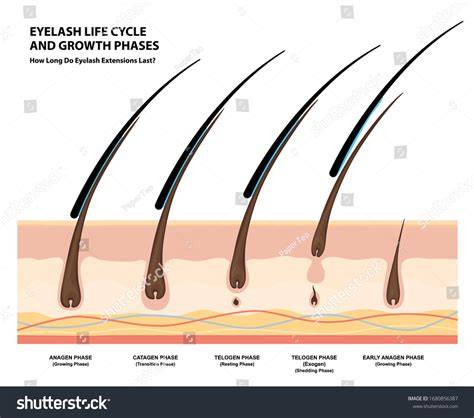
For many women eyelashes are a very important part of beauty. In fact, they have other important function of protecting the eye. Their main and primary task is to protect the eye from external factors (i.e. dust or dirt). Eyelashes grow on eyelids margins in two or three rows. On the upper eyelid there are 150 - 200 eyelashes, on the lower 50 - 150. Eyelashes of the upper eyelid reach a length 8 to 12 mm, while eyelashes of the lower eyelid from 6 to 8 mm. Eyelashes, similar to hair, do not grow continuously. Its growth has three phases: anagen, catagen and telogen. Eyelash growth cycle is however much shorter than the hairs and is about 3 - 4 months. Anagen phase is a phase of intensive hair growth, during which cells divide intensively inside the hair follicle to form hair shaft. For eyelashes this phase lasts for about 2 - 3 weeks. Then catagen phase (transition), associated with morphological changes and shrinking of the hair follicle begins. For eyelashes this lasts 2 to 3 weeks. After this period the hair begins the telogen phase, called resting phase, which is associated with loss of blood vessels around the bulb and hair follicle and as a result loss of a hair. This phase lasts for 60 days for eyelashes. After the eyelash falls out, the hair follicle is not damaged but returns to the growth phase again and the cycle is repeated. Growing, resting and falling eyelashes are distributed randomly along eyelids. About 60-80% of eyelashes is in an intensive growth phase. Falling of about 1 to 2 eyelashes per day is normal. Losing more eyelashes per day should raise concern.
The main cause of eyelash loss, as in case of scalp hair, is weakening of the hair follicles. Very common cause of eyelash loss is improper care and beauty treatments. Of particular significance is the eye makeup removal - whether it is forgot or performed improperly. Sleeping with eye makeup on can block hair follicles and cause skin irritations and as a result weakness and loss of eyelashes. Unremoved makeup causes mechanical damage to eyelashes - breaking off. Eyelashes condition is also affected by the way makeup is removed. When removing eye makeup, eyelids should not be rubbed too hard. After applying makeup remover you should wait for a while and then gently remove the dissolved mascara with a cotton pad. Another culprit of eyelash loss is an eyelash curler. Improper and frequent use can damage and break eyelashes. Eyelash weakening can also result from eyelash extensions. In order to keep lashes healthy, attention should be paid to proper care and strengthening. A great way to do that would be using the appropriate eyelash conditioner, rich in active substances that moisturize, regenerate and strengthen lashes (e.g. dermenum® lash conditioner). It is also important to choose the appropriate mascara that will not only be a part of makeup but also take care for condition of lashes and its healthy look (e.g. dermenum® lash mascara).
In case of eyelash growth disorders and its excessive loss, hair follicles should be provided with comprehensive actions to stimulate the activity of hair follicles and reduce eyelid inflammation. An important element is also dietary supplementation with nutrients responsible for proper growth and condition of hair (e.g. dermenum® complex). Eyelashes are more than just cosmetic fringe. Lashes protect the eye from debris that can obstruct vision or cause infection or injury. It’s normal to lose between one and five eyelashes each day. Irritation from cosmetics. Leaving eye makeup on for too long, using and removing lash extensions and using eyelash curlers (heated or non-heated) can all harm lashes and speed up shedding. Blepharitis. Itchiness or burning accompanied by redness or swelling of the lids may indicate blepharitis. Skin cancer. More rarely, localized lash loss can be a symptom of a skin cancer on the eyelid. If hair is falling out from the eyelids as well as the eyebrows and/or the scalp, this may be a sign of a systemic health problem or condition. Alopecia. This auto-immune disease causes the body to attack its own hair follicles, causing full, partial or episodic hair loss on the body, head or face. Long-term alopecia is often hereditary. Thyroid Disorder. The thyroid is a gland in the neck that controls the body's hormones. Both hyperthyroidism (an overload of hormones) and hypothyroidism (too few hormones) can cause lash and other hair loss.
Wash your face and eyelids daily with gentle soap and water. Latisse is an FDA-approved prescription eyelash growth treatment. It has been clinically studied and has demonstrated consistent eyelash growth. Over-the-counter lash serums may cause sensitivity or adverse reactions in some people. Consult with your ophthalmologist to determine if these products are appropriate for you.
Have you recently gotten lash extensions and noticed a few falling out already? Don’t worry; it’s pretty common to see some lashes come loose after a new set. Your natural lashes undergo a regular shedding cycle where old lashes fall out, and new ones grow in their place - something that is completely normal and part of having healthy lashes. But, if you’re feeling like your lashes are playing a disappearing act, there might be other factors at play.
Common Reasons for Premature Lash Loss
- Improper Aftercare: Not following the aftercare instructions can lead to early lash loss. Avoid water and steam for the first 24-48 hours, and be gentle when cleaning your face and eyes.
- Use of Oil-Based Products: Oils can weaken the bond between the lash adhesive and your natural lashes. Always opt for oil-free makeup removers and cleansers.
- Excessive Touching or Rubbing: Frequently touching or rubbing your eyes can cause lash extensions to loosen and fall out.
- Poor Application Techniques: If the lash extensions are not applied correctly, they won’t adhere properly to your natural lashes.
- Environmental Factors: Extreme weather conditions like high humidity or intense heat can weaken the adhesive used on lash extensions, causing them to fall out prematurely.
Tips for Maintaining Lash Extensions
- Gentle Cleansing: Use a gentle, oil-free, or lash-safe cleanser to keep your lashes clean without damaging the adhesive.
- Avoid Water Pressure: Be cautious in the shower and avoid direct water pressure on your face for the first 24-48 hours.
- Use Oil-Free Products: Steer clear of oil-based makeup and removers.
- Regular Fills: Schedule lash fills every 2-3 weeks to replace any fallen lashes.
- Sleep Carefully: Try to sleep on your back or with a silk or satin pillowcase to avoid ruffling your lashes.
- Brush Regularly: Gently brush your lashes daily with a clean spoolie brush to keep them neat and aligned.
Learn More and Schedule a Consultation for Personalized Lash Advice. At Deka Lash, our highly skilled lash artists are here to help with any questions you have - from “Why are my lash extensions falling out?” to “What are the best lash extensions for me?”. If you’ve ever noticed your eyelashes falling out at a quicker rate than normal, it can be quite alarming. This is because it directly conflicts with one of the most timeless beauty looks: long, thick eyelashes. Just take a look at the endless amounts of eyelash-enhancing products and beauty treatments out there. From at-home eye makeup products like lash primer, mascara, eyelash curlers, and eyelash serums to professional services including eyelash extensions and tinting treatments, the quest for lengthy, healthy eyelashes is at an all-time high.
Basically, it’s easy to see where the world’s priorities lie when it comes to the eyes, which brings us back to the distress caused by losing eyelashes. The thing is, as stressful as eyelash fallout feels, you shouldn't panic. If you’ve been researching and asking everyone you know, “why are my eyelashes falling out?” there are actually a number of reasons that could be causing your lashes to fall out. Not all eyelash fallout is cause for concern-healthy lashes naturally shed on their own! According to the American Academy of Ophthalmology (AAO), the natural cycle in which eyelashes grow, fall out, and replace themselves lasts between six to ten weeks. It’s actually the same rate at which the hair on your head naturally cycles, too.
If you’ve noticed that you’re losing more lashes than average, it could be a signal of a larger, underlying health problem-either in the eye or elsewhere in the body. And, as stressful as it is to your appearance, losing eyelashes can also present another issue: It leaves your eye vulnerable. That’s because eyelashes, in addition to their aesthetic value, are also necessary to protect the eye from things like debris, which can cause infection or injury. So, what causes eyelashes to fall out at a quicker rate than normal?
- The potential for eyelash loss is yet another reason to never, ever sleep with your makeup on! According to the AAO, leaving eye makeup on for too long can cause harm to your lashes and speed up their natural shedding cycle. So, always remove your eye makeup at the end of the day. Eyeliner, eye shadow, mascara, and concealer, take it all off!
- Another type of irritation leading to eyelash loss can be allergic.
- If your eyelash loss is accompanied by itchiness or burning, as well as redness or swelling of the eyelids, you could be suffering from a condition called blepharitis. According to the Mayo Clinic, this condition is marked by inflammation of the eyelids. While blepharitis doesn’t cause permanent damage to eyesight, it is extremely uncomfortable, often chronic in nature, and can be really difficult to treat.
- Additionally, there are many other causes of eyelash loss, although they’re considered to be less common in occurrence. These include alopecia, an auto-immune disease that causes the body to attack its own hair follicles, as well as thyroid disorders.
Eye Lash Growth Treatment animated explainer video London (custom)
With all of these possible causes, it can be confusing and stressful to figure out which eyelash loss symptoms warrant an immediate appointment with your doctor. According to the AAO, you should consult a physician right away if the lash loss is happening on both eyelids (upper and lower), you’re also experiencing hair loss on your scalp or eyebrows, you have other skin changes like itching or redness, you have a feeling of pressure around your eyes, or you’re experiencing any vision loss.